
What if the system that keeps your home warm during a January cold snap could also provide crisp air conditioning during a July heatwave, all while paying for itself through government incentives? Choosing between a heat pump vs furnace BC homeowners face can feel like a gamble, especially with natural gas rates jumping 11.1% this year and provincial rebate rules shifting as recently as July 2026. You want a comfortable home, but the technical jargon and complex application forms are enough to make anyone stick with their old, inefficient equipment.
We’re here to cut through the noise. You’ll discover the honest truth about heating your British Columbia home, from calculating real-world monthly energy savings to securing the maximum CleanBC rebates before they change again. This guide compares installation costs, explains how modern cold-climate technology handles our local winters, and provides a clear roadmap for a successful rebate application. Whether you live in a detached house in Coquitlam or a strata in the Lower Mainland, we’ll help you find the most efficient path to year-round comfort.
Key Takeaways
- Compare operating costs between BC Hydro electricity and FortisBC gas to see why the heat pump vs furnace BC debate is shifting in 2026.
- Navigate the latest CleanBC rebate requirements to maximize your savings before provincial funding levels change again.
- Learn how modern cold-climate heat pumps handle Lower Mainland freezes while providing essential air conditioning during summer heatwaves.
- Evaluate the hybrid “dual-fuel” model to ensure total peace of mind during extreme weather events without sacrificing efficiency.
- Assess your home’s electrical capacity and insulation levels to determine the most cost-effective installation path for your specific property.
Understanding the Technology: Moving Heat vs. Creating It
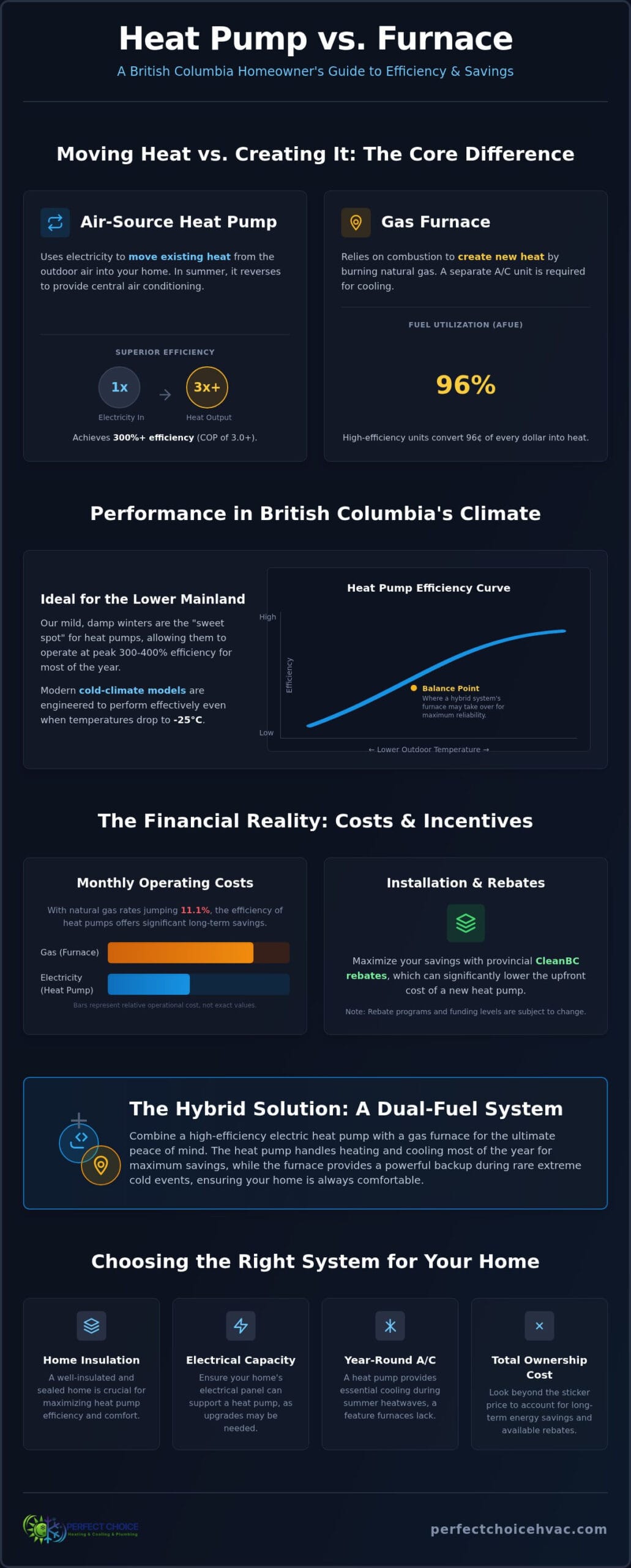
Deciding between a heat pump vs furnace BC homeowners often consider depends on understanding one fundamental difference. A furnace creates heat, while a heat pump moves it. These two systems represent completely different philosophies of home comfort. One relies on a powerful combustion process to generate warmth from scratch. The other uses advanced refrigeration technology to harvest existing thermal energy from the environment. This distinction dictates everything from your monthly utility bills to your home’s carbon footprint.
The easiest way to visualize a heat pump is to think of a refrigerator running in reverse. Your fridge doesn’t actually create “cold.” Instead, it strips the heat from the air inside the cabinet and vents it out the back. A heat pump does the exact same thing but on a much larger scale. In the winter, it extracts ambient heat from the outdoor air and pumps it into your living room. In the summer, the process flips. It pulls heat out of your home and dumps it outside, providing full air conditioning. A furnace is a one-way street; it only provides heat. If you want cooling with a furnace, you must install a separate central air conditioner.
How a Gas Furnace Operates
A gas furnace is a combustion-based powerhouse. When your thermostat calls for heat, the system opens a gas valve and ignites burners inside a sealed combustion chamber. This flame heats up a component called a heat exchanger. Your home’s air is then blown across the outside of this hot metal box, picking up warmth before it travels through your ducts. This process is incredibly reliable during the rare “Arctic Outflow” events we see in the Tri-Cities. Most modern units are rated by their Annual Fuel Utilization Efficiency (AFUE). A high-efficiency furnace with a 96% AFUE rating means that 96 cents of every dollar spent on gas goes toward heating your home, while the remaining four cents escapes through the exhaust vent.
The Mechanics of an Air-Source Heat Pump
An air-source heat pump relies on a closed loop of refrigerant, evaporator coils, and a high-powered compressor. Even when it feels freezing outside, there is still thermal energy present in the air. Understanding how a heat pump works involves seeing how the system uses electricity to compress this refrigerant, which concentrates the harvested heat to a temperature high enough to warm your home. Because the system is moving heat rather than burning fuel to create it, it can achieve efficiency levels of 300% or more. Coefficient of Performance (COP) measures the ratio of heat produced to electricity consumed; for instance, a COP of 3.0 means you get three units of heat for every unit of electricity paid for on your BC Hydro bill. This high level of efficiency is why provincial programs like CleanBC prioritize these systems for local homeowners.
Performance in the BC Climate: Lower Mainland Suitability
The Lower Mainland’s climate is practically built for heat pump technology. Unlike the BC Interior, our winters rarely see sustained weeks of double-digit negative temperatures. For most of the year, the outdoor air is a goldmine of thermal energy. This allows a heat pump to operate in its “sweet spot” of efficiency, often delivering 300% to 400% efficiency during the damp, cool months of November through March.
However, coastal humidity in places like Port Moody and Coquitlam adds a unique variable. When temperatures hover near zero degrees Celsius, moisture in the air can freeze on the outdoor coils. Modern systems handle this through an automatic defrost cycle. They briefly reverse the flow to melt the frost, ensuring the unit stays operational. While a gas furnace remains a reliable fail-safe during the rare “Arctic Outflow” events that bring extreme freezes, modern cold-climate technology has closed the gap. Recent advancements, many of which were spurred by the Cold Climate Heat Pump Technology Challenge, have led to units that maintain high performance even when temperatures drop to -25°C. When evaluating a heat pump vs furnace BC homeowners should consider if they prioritize this extreme-cold reliability or the year-round versatility of electricity.
Heat Pump Efficiency Curves
As the outdoor temperature plunges, a heat pump has to work harder to extract heat. Every system has a “Balance Point.” This is the specific temperature where the heat pump can no longer keep up with the home’s heat loss on its own. In the Tri-Cities, we look for systems with high HSPF2 (Heating Seasonal Performance Factor) ratings, which measure heating efficiency over a full season. A higher HSPF2 means lower BC Hydro bills during our long, drizzly winters. If you are curious about how these ratings apply to your specific layout, a free in-home estimate can help identify the right capacity for your home’s envelope.
The Summer Advantage: Built-in Air Conditioning
Recent BC heatwaves have fundamentally changed how we view home comfort. A furnace-only home requires a separate central air conditioning unit to stay safe during July and August. A heat pump provides this cooling natively. By installing one system instead of two, you simplify your maintenance schedule and save significant indoor floor space. Furthermore, heat pumps often feature superior filtration and variable-speed motors. These components provide more consistent air circulation and better indoor air quality compared to the “all-or-nothing” blast of a traditional single-stage furnace. This constant, gentle airflow helps manage the humidity levels that are so common in our coastal environment. For homes without existing ductwork, a ductless mini split installation Coquitlam professionals recommend can deliver the same year-round comfort without the need for major renovations.
The Financial Reality: Installation Costs, Monthly Bills, and BC Rebates
The sticker price of a new heating system is often the biggest hurdle for homeowners. A whole-home heat pump system generally requires a higher upfront investment than a high-efficiency gas furnace. However, looking at the initial cost in isolation is misleading. In the heat pump vs furnace BC debate, the true financial picture only emerges when you factor in operational savings and the “AC offset.” If you were already planning to add central air conditioning to your furnace, the net cost of a heat pump often becomes the more economical choice.
Operating costs are also shifting in favour of electricity. On January 1, 2026, FortisBC implemented an 11.1% increase to residential gas bills. This hike adds roughly C$10.95 per month to the average household budget. While BC Hydro also saw a 3.75% rate increase in April 2026, electricity remains a highly stable energy source. Average Lower Mainland households switching from gas to a heat pump are currently saving between C$200 and C$350 per year on total energy costs. These savings are bolstered by the fact that heat pumps operate at 250% to 400% efficiency, whereas even the best gas furnaces top out at 98%.
Maintenance and long-term value also play a role. A furnace requires annual burner and heat exchanger inspections to ensure safety and prevent carbon monoxide leaks. Heat pumps require regular coil cleaning and filter changes to maintain their high efficiency. From a resale perspective, BC buyers are increasingly prioritizing “climate-ready” homes. A property equipped with a modern heat pump is often more attractive to buyers who want to avoid the rising carbon tax on natural gas and the discomfort of future summer heatwaves.
Navigating 2026 BC Heat Pump Rebates
Rebate structures changed significantly on July 6, 2026. The CleanBC Better Homes Energy Savings Program reduced some income-qualified amounts, but substantial funding remains available. For a standard conversion from a gas furnace to a ducted heat pump, you can still access rebates up to C$13,000. If you combine this with a heat pump water heater, that total can reach C$16,500. To qualify for any of these provincial incentives, you must hire a CleanBC registered contractor HVAC. These professionals are vetted by the province to ensure your system is sized and installed correctly to meet strict efficiency standards.
Calculating Your Return on Investment (ROI)
Your ROI is influenced by the tiered billing system in British Columbia. With the BC Hydro Step 2 rate sitting at C$0.1408/kWh for consumption over 1,376 kWh, high-efficiency equipment is essential to keep bills low. When you calculate your ROI, remember to subtract the cost of a standalone air conditioner, which typically runs between C$4,500 and C$6,000. By avoiding that second installation, your heat pump starts “in the green” much sooner. Additionally, the federal government still offers an interest-free loan of up to C$40,000 through the Canada Greener Homes Loan, allowing you to spread the cost over ten years without paying a cent in interest.
The Hybrid Solution: A Dual-Fuel System for Total Peace of Mind
If you are torn between the heat pump vs furnace BC decision, there is a middle ground that offers the best of both worlds. A dual-fuel system pairs an electric heat pump with a high-efficiency gas furnace. For about 90% of the year, the heat pump handles all the heating and cooling needs for your home. It operates with the high efficiency we discussed in previous sections. However, when temperatures drop below a specific “switch point,” a smart thermostat automatically engages the gas furnace to take over the heavy lifting.
This setup eliminates the “range anxiety” some homeowners feel regarding all-electric systems. Instead of relying on electric backup strips, which can be expensive to run, you have the raw power of natural gas for those rare Arctic Outflow events. It is a strategic way to transition toward greener energy without giving up the reliability of a traditional combustion system. Many homeowners in Coquitlam find this provides the ultimate peace of mind during unpredictable winter weather.
When Hybrid Makes the Most Sense
A hybrid system is often the most practical choice for older homes in the Tri-Cities. Many heritage properties or houses built before the 1990s lack the high-performance insulation required to keep an all-electric system running at peak efficiency during a freeze. Furthermore, a full electric conversion often requires a 200-amp electrical panel upgrade. If your current panel is maxed out, a dual-fuel system allows you to keep your gas infrastructure while still enjoying the benefits of a heat pump.
Strata considerations also play a major role here. In many Lower Mainland townhomes, getting approval for a full electric conversion can be difficult due to shared utility limits. A hybrid model is often easier for strata councils to approve because it maintains the existing gas connection as a primary or secondary source. If you are struggling with complex strata requirements, we can help you book a consultation to review which setup fits your specific bylaws and building type.
Pros and Cons of Dual-Fuel
Every heating configuration has trade-offs. While dual-fuel is a versatile solution, you should weigh these factors before deciding:
- Pro: Unmatched Reliability. You have two independent heat sources. If one system has a mechanical issue, the other acts as a built-in backup.
- Pro: Optimized Costs. Smart thermostats calculate whether gas or electricity is cheaper based on current outdoor temperatures and utility rates.
- Con: Upfront Investment. You are essentially paying for two pieces of equipment. This results in a higher initial price tag than a standalone furnace.
- Con: Maintenance Requirements. Because you have both a combustion system and a refrigeration system, you need to maintain both to keep warranties valid.
- Pro: Rebate Eligibility. While full conversion rebates are higher, FortisBC still offers incentives for qualifying dual-fuel systems that help offset the initial cost.
Decision Framework: Choosing the Right System for Your Tri-Cities Home
Choosing the right path in the heat pump vs furnace BC debate requires a look at your home’s infrastructure. Every property in Coquitlam and the surrounding Tri-Cities is unique. Your home’s “envelope”, the insulation, windows, and airtightness, dictates which system will be most efficient. A professional heat load calculation is the only way to be certain. This technical assessment ensures your new equipment is sized perfectly for your square footage and insulation levels. This prevents the short-cycling or under-performance that often happens with generic estimations.
One critical factor is your electrical panel capacity. A whole-home heat pump usually requires a 200-amp service. If your older home is still running on a 100-amp panel, an upgrade is necessary. While this adds to the initial scope, it’s also a major step in future-proofing your property. BC building codes and provincial policies are moving steadily toward electrification. Investing in that capacity now prepares your home for future technology, from EV chargers to high-efficiency appliances. It’s a move that protects your home’s value as gas infrastructure becomes more expensive to maintain.
The “Furnace First” Checklist
While heat pumps are the provincial priority, a high-efficiency gas furnace might still be the right call for specific scenarios. Consider a furnace if:
- You are working with a very tight immediate budget and don’t require summer cooling.
- Your electrical panel is maxed out, and the cost of a 200-amp upgrade is currently out of reach.
- You live in a region with significantly colder winters than the Lower Mainland, where gas remains a primary necessity.
- Your home has poor insulation that would make an electric-only system work too hard during a freeze.
The “Heat Pump Hero” Checklist
For most Lower Mainland residents, the shift to electricity offers the best long-term return. A heat pump is likely your winner if:
- You want to eliminate your monthly gas bill and reduce your home’s carbon footprint.
- You need a reliable air conditioning solution to handle increasingly frequent BC heatwaves.
- You qualify for the maximum CleanBC heat pump rebate Coquitlam incentives, which can cover a massive portion of the switch.
- You want a single, integrated system that provides consistent comfort through all four seasons.
The final choice depends on your specific goals. If you value the lowest possible monthly bill and year-round climate control, the heat pump is the clear 2026 winner. If upfront cost is your only barrier, a high-efficiency furnace remains a dependable, if less versatile, workhorse. Whatever you choose, ensure you work with a registered professional to secure your rebates and guarantee your home stays comfortable during the next winter freeze.
Secure Your Home’s Comfort for the Next Decade
Choosing between a heat pump vs furnace BC homeowners trust depends on balancing immediate installation costs with long-term energy stability. We’ve explored how modern cold-climate technology handles our unique coastal freezes while providing essential relief during summer heatwaves. Whether you opt for the raw power of a high-efficiency furnace or the 300% efficiency of an electric heat pump; your decision will shape your home’s comfort and resale value for years to come.
As a locally owned, licensed, and insured CleanBC Registered Program Contractor, we’re here to simplify the transition. Our team provides expert assistance with complex rebate applications and strata paperwork to ensure you don’t leave money on the table. We understand the specific needs of Tri-Cities neighbourhoods and can help you navigate the 2026 utility landscape with confidence. Ready to find the perfect fit for your property? Get a Free In-Home Estimate for Your Heat Pump or Furnace Today. Your most comfortable winter yet is well within reach.
Frequently Asked Questions
Is a heat pump really better than a gas furnace for BC winters?
Yes, for the Lower Mainland’s moderate climate, a heat pump is generally superior due to its extreme efficiency. While gas furnaces provide raw heat during rare Arctic Outflow events, modern cold-climate heat pumps maintain performance down to -25°C. This makes them a more versatile choice for the heat pump vs furnace BC comparison in 2026, as they handle our damp winters while providing summer cooling.
Do heat pumps work during a BC power outage?
No, heat pumps require electricity to run the compressor and fans. Both heat pumps and modern high-efficiency furnaces need a power source to circulate air through your ducts. If you live in an area prone to outages, you might consider a backup generator. Unlike some older gas fireplaces that can operate with a battery backup, these central systems won’t run without a stable electrical connection.
How much can I save with CleanBC heat pump rebates in 2026?
You can still access rebates up to C$13,000 for a standard gas-to-electric ducted heat pump conversion. Even with the July 2026 reductions for income-qualified tiers, the standard C$4,000 rebate for switching from electric baseboards remains available. Combining a heat pump with a heat-pump water heater can push your total provincial savings to C$16,500, significantly offsetting the initial investment.
Will a heat pump be loud enough to bother my neighbours in a strata?
Modern heat pumps are remarkably quiet, typically operating between 50 and 60 decibels. This volume is similar to a normal conversation or a quiet dishwasher. Strata councils often worry about vibration and noise; however, professional installations include rubber isolation pads and sound blankets. These measures ensure the unit doesn’t disturb your neighbours, even in high-density townhome complexes in Coquitlam or Port Moody. For a detailed walkthrough of the approval process and which whisper-quiet models meet strata requirements, our guide to strata heat pump installation BC covers everything from Standard Bylaws to noise compliance.
Can I keep my existing furnace and just add a heat pump?
Yes, this configuration is known as a dual-fuel or hybrid system. It allows you to use the heat pump for efficient heating and cooling during most of the year while keeping your furnace as a backup for extreme cold. This is a popular option in the Tri-Cities for homeowners who aren’t ready to go fully electric but want to lower their carbon footprint and gain air conditioning.
What is the lifespan of a heat pump compared to a furnace?
A well-maintained heat pump typically lasts about 15 years, while a high-efficiency gas furnace can last 20 years or more. Because heat pumps work year-round for both heating and cooling, they accumulate more mechanical wear than a furnace that only runs in the winter. Regular annual maintenance is vital to ensure both systems reach their maximum operational life in our coastal climate.
Do I need to upgrade my electrical panel for a heat pump installation?
Most whole-home heat pump installations require a 200-amp electrical panel to handle the increased load. If your home currently has a 60-amp or 100-amp service, an upgrade will likely be necessary. While this is an additional upfront cost, it future-proofs your property for other electric technologies. It’s also often a mandatory requirement for securing the highest heat pump vs furnace BC rebate tiers.
Which system is better for indoor air quality in the Lower Mainland?
Heat pumps generally offer better indoor air quality because they provide constant, gentle air circulation. Unlike furnaces that deliver heat in intense, dry blasts, heat pumps use variable-speed motors to move air continuously through high-grade filters. This consistent movement helps manage humidity levels and reduces the buildup of allergens and dust, which is particularly beneficial in our humid coastal environment.
