

What if your new home comfort system arrived with a strata fine instead of a lower energy bill? For many homeowners, the process of a strata heat pump installation BC feels more like a legal battle than a simple home upgrade. You want the efficiency and cooling, but the fear of violating Standard Bylaws or triggering a noise complaint often stops the project before it starts. It’s a stressful position to be in when you just want a more comfortable living space.
We realize that navigating exterior alterations and electrical load requirements is overwhelming. You shouldn’t have to guess which forms to fill out or worry about forced removals. This guide provides a clear, step-by-step roadmap to get your project approved and installed correctly. You’ll learn how to navigate the differences between Standard Bylaws 5 and 6, identify which whisper-quiet models are strata-friendly, and how to maximize your BC Hydro and CleanBC rebates. We’ve broken down the technical hurdles so you can move forward with confidence and secure your home’s future comfort.
Key Takeaways
- Learn how to navigate the legal distinction between your strata lot and common property to avoid fines during your upgrade.
- Identify the specific technical requirements for electrical loads and space constraints that make a strata heat pump installation BC successful in 2026.
- Discover the exact steps for obtaining council approval, including how to prepare the professional spec sheets and noise data that strata boards require.
- Maximize your investment by identifying which 2026 BC Hydro and CleanBC rebate programs apply to your specific building type and unit.
Navigating the Complexities of Strata Heat Pump Installation in BC
A strata heat pump installation BC is more than a simple appliance upgrade. It is a unique hybrid project that crosses the boundary between your private strata lot and the building’s common property. While the indoor head sits on your wall, the outdoor compressor and the refrigerant lines connecting them typically attach to the building exterior. This dual nature means you aren’t just installing equipment; you’re modifying the shared structure of the community. Understanding this distinction is the first step toward a successful installation that keeps both your home cool and your strata council happy.
Why Strata Owners are Upgrading in 2026
The demand for heat pumps in BC has shifted from a luxury to a necessity. Recent years have brought record breaking heatwaves to the Lower Mainland, making traditional electric baseboard heating feel outdated and insufficient. Owners are choosing these systems because they provide highly efficient heating in the winter and powerful cooling in the summer. Beyond personal comfort, upgrading to a ductless mini-split system significantly reduces monthly energy bills compared to old resistance heaters. It also increases the resale value of your unit, as modern buyers now prioritize homes with built in climate control.
The Legal Framework: Standard Bylaws 5 and 6
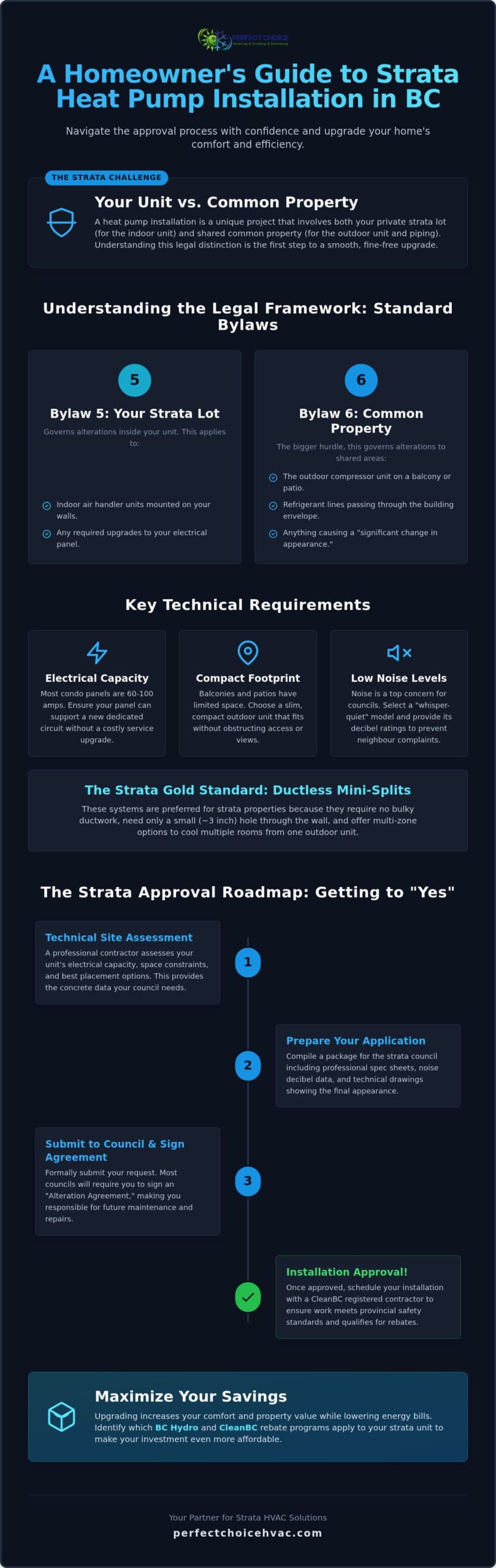
The Strata Property Act (SPA) provides the baseline rules for how these installations are governed. Most BC stratas follow Standard Bylaws, which divide the project into two legal categories. Bylaw 5 covers alterations to a strata lot. This applies to the indoor air handlers and any upgrades needed for your electrical panel. Bylaw 6 is often the bigger hurdle, as it governs alterations to common property. This includes the outdoor compressor unit and the line sets that pass through the building envelope.
Councils often focus on the “significant change in appearance” clause. This is a common legal hurdle because an outdoor unit on a balcony or a line set cover on a brick wall changes how the building looks. To get past this, you need a plan that minimizes visual impact and addresses potential noise. Most councils will require an Alteration Agreement that shifts the responsibility for future maintenance and repairs from the strata corporation to you, the individual owner.
Choosing a CleanBC registered contractor is vital for navigating these legal waters. A professional team doesn’t just install the hardware; they act as a liaison by providing the technical drawings and sound decibel ratings your council needs to see. This documentation proves the installation meets both provincial safety standards and your specific strata bylaws. By using an experienced partner, you ensure the work is done right the first time, protecting your investment and your relationship with your neighbours.
Technical Requirements and Strata-Friendly Systems
Strata units have limited real estate for HVAC equipment. Balconies and patios often serve as the only viable spots for outdoor compressors. Selecting a unit with a compact footprint is essential for a successful strata heat pump installation BC. Beyond physical size, you must consider your electrical panel capacity. Most older condo units operate on 60 to 100 amp service. A modern heat pump is highly efficient, but it still requires a dedicated circuit that fits within your home’s total electrical budget without triggering a costly service upgrade.
Space is not the only technical hurdle. Building envelopes in BC are strictly protected to prevent water ingress. This means any penetration through the exterior wall must be sealed to professional standards. If you are unsure if your balcony or electrical panel can support a specific model, request a technical site assessment to get the concrete data your council will inevitably ask for.
Ductless Mini-Splits: The Strata Gold Standard
Ductless mini-split installation in Coquitlam is the preferred strata choice for several reasons. These systems do not require bulky ductwork, making them ideal for retrofitting older buildings. The refrigerant line sets are small, usually requiring only a three inch hole through the exterior wall. This minimizes building envelope risks and satisfies council concerns about structural integrity. For larger strata townhomes, multi-zone options allow one outdoor compressor to power several indoor units, which saves precious patio space while providing custom comfort in every room.
Managing Noise and Vibration
Noise is the primary reason strata councils reject applications. You need to understand the difference between municipal noise bylaws and your strata’s specific decibel limits. Councils often set stricter standards to ensure neighbours aren’t disturbed at night. Most high quality units now operate at sound levels comparable to a quiet conversation. A decibel rating measures the intensity of sound, with modern quiet-run heat pumps often operating between 45 and 58 dB.
Vibration isolation pads are a standard requirement for almost every strata install. These rubberized mounts act as shock absorbers between the compressor and the balcony surface. They prevent structural vibration from transferring through the floor and into the unit below. Using these pads, combined with a precision installation, ensures your system remains a silent partner in your home comfort rather than a source of community friction.
The Strata Approval Roadmap: Getting to Yes
Securing a strata heat pump installation BC requires more than a simple request. You are building a case for your council to review. A successful application proves that your project won’t disturb neighbours or damage the building’s integrity. Most councils hesitate because they fear noise complaints or water leaks. By following a methodical roadmap, you address these concerns before they become roadblocks.
Your first step is a thorough review of your specific strata bylaws. While we discussed the legal framework of the Strata Property Act earlier, your building may have unique rules regarding compressor placement or the colour of line set covers. Once you understand the rules, obtain a professional quote. This isn’t just about price. You need a technical spec sheet that outlines the exact dimensions and noise ratings of the equipment. This data is the foundation of your proposal.
The next phase involves the Alteration Agreement. This legal document is common in BC strata living. It shifts the responsibility for the maintenance and future repair of the heat pump from the strata corporation to you. It’s a fair trade for the right to modify common property. After the agreement is drafted, submit your formal package to the council or property manager. Be prepared to negotiate. If they have concerns about the visual impact, be ready to suggest alternative line set paths or decorative screening that matches the building’s aesthetic.
What to Include in Your Council Application
A vague application is an easy target for a denial. You want to provide a “plug and play” package that council members can approve quickly. Your submission should include:
- Manufacturer spec sheets: Highlight the low decibel (dB) ratings to prove the unit is whisper quiet.
- Detailed diagrams: Show exactly where the compressor will sit and the path the line sets will take through the wall.
- Contractor credentials: Include proof of insurance and current WCB coverage to protect the strata from liability.
Handling a Denial: Human Rights and Extreme Heat
If your council says no, don’t lose hope. The 2026 landscape in BC has shifted toward recognizing cooling as a necessity for health and safety. You can appeal a denial by highlighting the system’s energy efficiency and climate resilience. In some cases, owners have successfully argued for an installation based on medical necessity during extreme heat events. If the council’s refusal seems unreasonable, you might suggest a building wide bylaw amendment. This proactive approach often turns a personal request into a community improvement project that benefits everyone’s property value.
Maximizing BC Heat Pump Rebates for Strata Units
The financial side of a strata heat pump installation BC has never been more favourable than in 2026. Provincial and federal incentives are designed to help multi unit residential buildings transition away from inefficient heating. However, these programs have strict entry requirements that you must follow before you buy your equipment. Missing a single step in the application process can disqualify you from thousands of dollars in savings, so it’s vital to plan your finances alongside your technical approval.
The most critical requirement for any rebate is your choice of professional. You must use a CleanBC Registered Contractor to be eligible for these funds. These professionals have the specific certifications required by BC Hydro and the provincial government to ensure the system is installed to high efficiency standards. If you hire an unregistered technician, you will likely lose your rebate eligibility entirely. Most programs also require a specific sequence: you often need to apply for pre-approval before the old system is removed or the new one is installed.
Individual Unit vs. Strata Corporation Rebates
Rebate structures differ depending on your building type and your current energy source. If you live in a high rise apartment and are switching from electric baseboard heaters, you will primarily look at BC Hydro incentives. For townhome owners switching from fossil fuels like gas or oil, CleanBC offers a different set of programs. In 2026, CleanBC provides a bonus for strata-wide adoptions where multiple units in the same building upgrade simultaneously. This encourages community-wide efficiency and can significantly lower the individual cost for every owner involved.
The ROI of a Heat Pump in a BC Strata
Investing in a heat pump provides a much faster return on investment than many owners realize. When comparing a heat pump vs furnace in BC, the heat pump wins on versatility by providing both heating and cooling from a single system. This dual-purpose function eliminates the need for separate air conditioning units, which are often banned by strata bylaws due to noise or window damage. Professional maintenance is the key to protecting this ROI. It ensures your system runs at peak efficiency and keeps your manufacturer warranty valid, which is a common requirement in many strata alteration agreements. Knowing the signs your heat pump needs professional repair is equally important, as catching issues early prevents costly breakdowns that could jeopardize your strata alteration agreement.
Modern heat pumps also help buildings align with the BC Energy Step Code. As municipalities move toward higher efficiency standards, having a heat pump installed makes your unit more attractive to future buyers. You aren’t just saving on your monthly hydro bill; you’re future-proofing your property value. If your existing system is aging and struggling to keep up, exploring a heat pump replacement Coquitlam residents rely on can help you understand current costs and 2026 rebate opportunities before you commit. To ensure you don’t miss out on current incentives, schedule a rebate consultation to verify which 2026 programs apply to your specific unit.
Why Perfect Choice HVAC is the Preferred Strata Partner
Experience matters when your home comfort depends on council approval. Our team brings 8+ years of hands-on HVAC experience in the Tri-Cities area helping owners overcome the hurdles of high density living. We understand that a strata heat pump installation BC isn’t just about the hardware. It’s about the community. We act as your technical advocate. We provide the decibel ratings and structural diagrams that councils demand. This reduces the friction between you and your neighbours and speeds up the “yes” you need to move forward.
Our installations prioritize the building envelope. We treat your common property with the same care as our own homes. We use precision tools to ensure every wall penetration is sealed according to BC building standards. This protects the strata from water ingress and protects you from future liability claims. We also include high grade vibration isolation as a standard part of our setup. This ensures your compressor remains silent for the unit below you, fulfilling the noise requirements we discussed earlier in this guide.
We offer long term maintenance plans specifically designed for high density residential living. These plans include regular efficiency checks that satisfy the requirements of most strata alteration agreements. By keeping your system in top shape, we protect your manufacturer warranty and your relationship with the strata council. You can rest easy knowing that your cooling system is a quiet, efficient addition to the building rather than a source of community tension.
Local Expertise in the Lower Mainland
We’ve worked with many of the major strata management companies across the Lower Mainland. We know their specific requirements and the common reasons they deny applications. This local insight allows us to prepare your package correctly the first time. We also realize that living in a shared building means space and noise are sensitive issues. Our team maintains a clean, non-disruptive workspace to keep your neighbours happy during the transition. For more local insights, check out our Ultimate Guide to Heat Pump Installation in Coquitlam.
Start Your Strata Upgrade Today
Ready to move away from baseboard heaters? We offer free in-home estimates to assess your unit’s electrical capacity and spatial constraints. We don’t just give you a price; we give you a roadmap. Our status as a CleanBC registered contractor means we handle the heavy lifting for your BC Hydro and CleanBC rebate paperwork. We ensure you meet every deadline and technical requirement to maximize your 2026 savings.
Don’t let the fear of strata bylaws keep you in an uncomfortable home. We provide the daily 7:00 AM–9:00 PM support and technical expertise needed for successful strata living. Contact us today to realize your strata cooling goals and start your journey toward a more efficient, comfortable home.
Secure Your Year-Round Comfort and Strata Approval
Upgrading your home shouldn’t be a source of stress. You now have the roadmap to handle the legal complexities of Bylaws 5 and 6 while selecting a whisper-quiet system that satisfies even the strictest councils. By focusing on technical precision and maximizing your 2026 rebate eligibility, you can turn a complex project into a seamless transition. A successful strata heat pump installation BC is entirely possible when you combine professional documentation with the right local expertise.
Our team is here to act as your strata liaison. As a CleanBC Registered Contractor with licensed, insured, and bonded technicians, we provide the expert strata approval support you need to get to “yes” faster. We’ll help you manage the paperwork and ensure your installation meets every building standard. Request a Strata-Ready Heat Pump Quote from Perfect Choice HVAC and take the first step toward a more efficient home. You deserve a living space that stays comfortable through every BC season.
Frequently Asked Questions
Can my BC strata council legally say no to a heat pump installation?
Yes, a strata council can legally deny a request if the project involves a significant change to common property or violates specific building bylaws. However, unreasonable denials are becoming harder to justify under 2026 provincial guidelines that prioritize climate resilience and cooling rights. If your council says no, you have the right to request a hearing to discuss energy efficiency and medical necessity.
How much noise does a strata-approved heat pump actually make?
Modern strata-approved units typically operate between 45 and 58 decibels, which is similar to the volume of a quiet conversation. These systems are significantly quieter than the portable air conditioners often found in condo windows. When installed with vibration isolation pads, the sound is usually undetectable to neighbours living in adjacent units.
Who is responsible for the maintenance of a heat pump in a strata unit?
The individual unit owner is almost always responsible for all maintenance and repair costs. This responsibility is formalized through an Alteration Agreement that you sign during the strata heat pump installation BC approval process. This agreement ensures that the strata corporation isn’t held liable for the upkeep or any future mechanical failures of your private system.
Do I need a building permit from the City of Coquitlam for a strata install?
Yes, most municipalities in the Lower Mainland require an electrical permit and sometimes a building permit for these upgrades. These permits verify that your unit’s electrical panel can handle the new load and that the exterior compressor is mounted safely. A professional contractor will typically manage these permit applications as part of the installation service.
What happens if my heat pump installation causes a leak in the building envelope?
If an installation causes a water leak, the unit owner is typically liable for the resulting damages to the common property. This is why using a licensed, insured, and CleanBC registered contractor is critical for your protection. Professionals use specialized sealants and flashing techniques designed specifically for BC’s wet climate to ensure the building’s exterior remains watertight.
Are there specific heat pump brands that strata councils prefer in BC?
Councils don’t usually mandate specific brands, but they favour manufacturers that provide detailed decibel ratings and compact outdoor units. Systems that offer a small footprint are easier to approve for limited balcony spaces. We recommend choosing a model with a proven track record for quiet operation to minimize the risk of noise complaints from your neighbours.
Can I install a heat pump if I only have 60-amp electrical service in my condo?
You can often install a highly efficient heat pump on a 60-amp panel, but it requires a precise load calculation first. Modern inverter technology allows these systems to provide powerful cooling while drawing significantly less power than older appliances. If your total electrical demand is too high, a professional can suggest energy management tools to help you stay within your panel’s capacity.
How long does the strata approval process typically take in the Lower Mainland?
The approval process usually takes between 2 and 6 weeks depending on your council’s meeting schedule. You can speed up this timeline by submitting a complete application package that includes technical spec sheets, contractor insurance, and a clear diagram of the line set path. Providing all the facts upfront prevents the “back and forth” that often delays strata heat pump installation BC projects.