Last Tuesday, a homeowner in Coquitlam discovered that even a large hot water tank couldn’t handle three back-to-back showers. It’s a frustrating, shivering reality for many families still relying on outdated technology. If you’re tired of running out of hot water or watching your energy bills climb while heating a massive, unused tank, you aren’t alone. A professional tankless water heater installation in Coquitlam offers a permanent solution, providing endless hot water while freeing up valuable space in your mechanical room.
We understand that switching systems can feel like a complex technical hurdle. A successful installation is actually 20% mounting the unit and 80% preparing the infrastructure to handle on-demand loads. This guide simplifies that process by walking you through sizing, gas line requirements, and the 2026 installation timeline. You’ll learn how to choose the right capacity and navigate current FortisBC rebates. By the end, you will have the clarity and confidence needed to reclaim your home’s comfort and efficiency.
Key Takeaways
- Learn how to calculate the correct flow rate and temperature rise based on local Coquitlam winter conditions to ensure your system meets peak demand.
- Understand the vital technical upgrades required for a successful tankless water heater installation, including gas line capacity and specialized venting.
- Compare the operating costs and installation complexity of gas versus electric systems to determine the best fit for your home’s infrastructure.
- Identify the necessary maintenance habits, such as annual flushing, that preserve your manufacturer warranty and keep the unit running efficiently for decades.
- Discover how to maximize your savings by navigating 2026 FortisBC rebates and provincial incentives available for high-efficiency upgrades.
Understanding Tankless Water Heater Installation: Why Make the Switch?
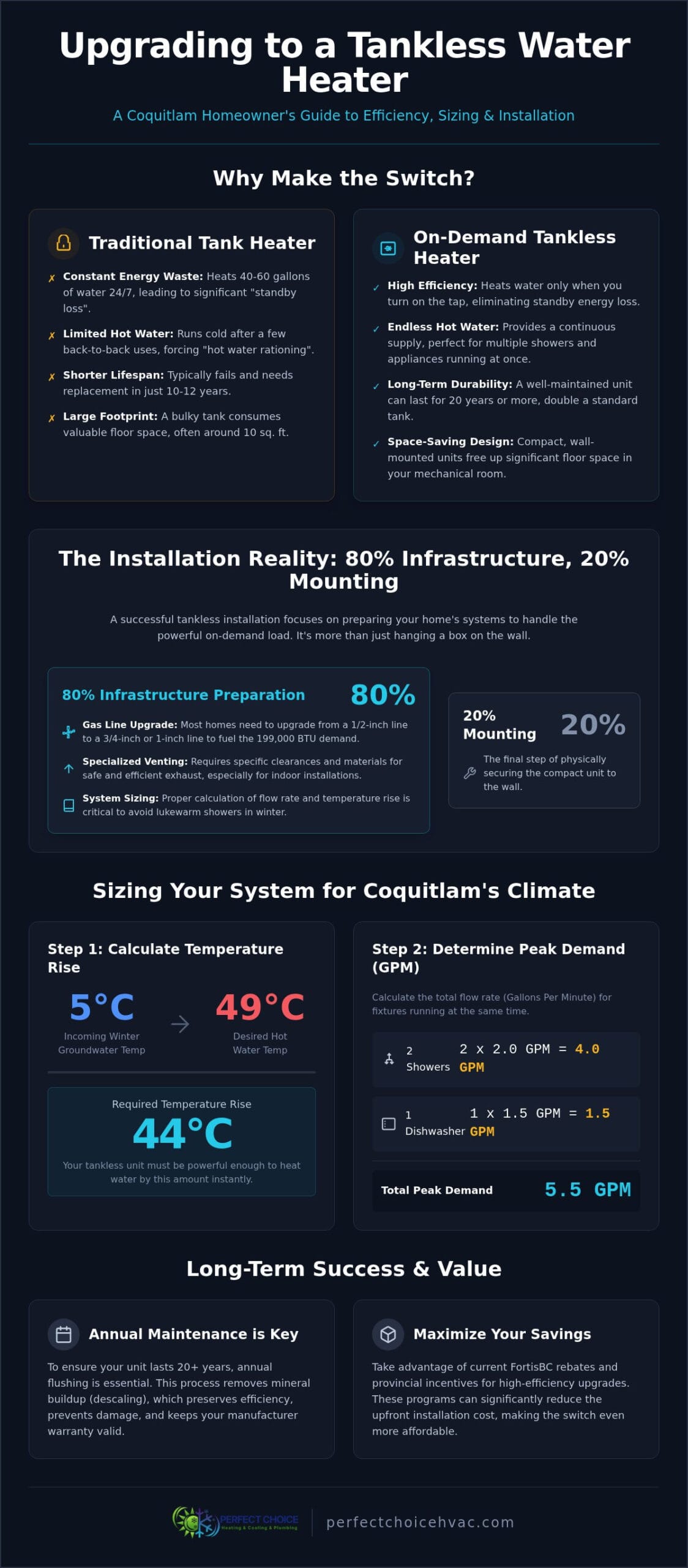
Traditional water heaters operate like a giant kettle that never turns off. They keep 40 to 60 gallons of water hot 24 hours a day; even when you’re sleeping or at work. This leads to “standby loss,” where energy is constantly wasted to maintain temperatures. In contrast, on-demand water heaters only activate when you turn on a hot water tap. When you invest in a professional tankless water heater installation, you’re switching to a system that flash-heats water using high-powered burners or elements only when it’s actually needed.
The most immediate change for your household is the end of the “hot water rationing” era. You can run the dishwasher, start a load of laundry, and take a long shower without the water turning cold halfway through. For many families in the Lower Mainland, this reliability is the primary reason for the upgrade. It transforms morning routines from a race against the clock into a stress-free experience. Beyond the convenience, removing a bulky 50-gallon tank can reclaim nearly 10 square feet of floor space. This is a massive benefit for smaller Coquitlam townhomes and condos where every centimetre of storage counts.
The Long-Term Value Proposition
A standard hot water tank typically lasts about 10 to 12 years before the internal lining begins to fail. A well-maintained tankless unit can serve your home for 20 years or more. While the upfront cost is higher, the monthly savings on your FortisBC or BC Hydro bills add up quickly. Because these units don’t suffer from standby energy loss, they are significantly more efficient. Additionally, high-efficiency mechanical systems are a major selling point in the local real estate market. Buyers recognize the value of a home that is already optimized for lower utility costs and modern performance.
Is Your Home a Candidate for Tankless?
A successful tankless water heater installation requires a look at your home’s current infrastructure. We start by assessing your peak hot water demand. If your household uses multiple fixtures simultaneously, we need to size the unit to handle that specific flow rate. Physical constraints also matter. While the unit itself is small and wall-mounted, it requires specific clearance for venting and gas lines. Most modern homes can easily accommodate these requirements, but older properties might need a gas line upgrade to handle the higher BTU load. We’ll help you determine if your current electrical panel or gas supply is ready for the transition.
Sizing and Technical Requirements: Preparing Your Home for On-Demand Hot Water
Sizing a tankless system is about more than counting the number of bathrooms in your home; it is a calculation of physics and local climate. In Coquitlam, our winter ground water is significantly colder than in southern regions. When the water enters your home at 5°C, your unit has to work much harder to hit a comfortable 49°C. This is known as the “temperature rise.” If you choose a unit based on its maximum GPM (gallons per minute) rating without accounting for our local climate, you will likely end up with a lukewarm shower in January. A successful tankless water heater installation requires matching the unit’s BTU output to these specific Canadian conditions.
Your home’s infrastructure must also be ready for the change. Most traditional tanks use a 1/2-inch gas line. However, a tankless unit can require up to 199,000 BTUs of gas the moment you turn on a tap. This sudden demand often necessitates a 3/4-inch or 1-inch gas line upgrade. Without enough fuel, the unit will error out or fail to reach the desired temperature. While some homeowners consider installing a tankless water heater outside to save interior space, our freezing winter temperatures usually make indoor installation the safer and more reliable choice for local residents. If your existing unit is already showing signs of strain, reviewing a complete tankless water heater replacement checklist for Coquitlam can help you determine whether an upgrade is overdue before a breakdown forces your hand.
The Math Behind the Flow
To determine the right size, you need to calculate your peak demand. A standard shower uses about 2.0 GPM, while a kitchen faucet uses roughly 1.5 GPM. If your household often runs two showers and a dishwasher simultaneously, you need a unit capable of providing at least 5.5 GPM at a 45°C rise. For multi-storey homes, we also consider the distance the water must travel. If you aren’t sure about your home’s capacity, our technicians can provide a professional sizing assessment to ensure your system meets your family’s needs.
Infrastructure Assessment Checklist
Venting is a critical safety requirement that differs significantly from older tank technology. Modern condensing units produce acidic exhaust, which requires specialized PVC or CPVC venting instead of old-fashioned metal B-vents. You must also account for the following technical needs:
- Gas Meter Capacity: Your meter must be able to handle the combined load of your furnace, fireplace, and the new tankless unit.
- Electrical Access: Even gas units require a dedicated 120V outlet to power the electronic igniter and internal control board.
- Condensate Management: High-efficiency units produce acidic liquid as a byproduct. This must pass through a neutralizer before entering your home’s drainage system to protect your pipes.
Gas vs. Electric Tankless Systems: Comparing Installation Complexity and Performance
Choosing between gas and electric units is the most critical decision in your tankless water heater installation process. It isn’t just a matter of fuel preference; it’s a question of what your home’s infrastructure can actually sustain. While electric models seem simpler because they lack exhaust flues, the electrical requirements are often more invasive and expensive than gas venting. In British Columbia, the cost gap is also noticeable. Natural gas remains a cost-effective way to heat water compared to the Tier 2 rates of BC Hydro. For a busy household, the monthly savings with gas add up significantly over the 20-year life of the unit.
Our local climate also favours gas for performance. As discussed in previous sections, Coquitlam’s winter water is quite cold. Gas burners can generate massive amounts of heat instantly to overcome that 40-degree temperature rise. Electric elements often struggle to maintain a high flow rate when the incoming water is near freezing. Regardless of the fuel type you choose, both systems require an annual flush. This maintenance prevents mineral scale from coating the heat exchanger, which ensures the unit continues to operate at its rated efficiency.
The Realities of Electric Tankless
A whole-home electric unit is a power-hungry beast. These systems often require three or four dedicated 40-amp breakers. For most Coquitlam homes with a standard 200-amp service, this might leave very little room for your oven, dryer, or EV charger. If your panel is already full, the cost of an electrical service upgrade can be substantial. Electric models are usually best suited as point-of-use units for a single remote bathroom or a small suite rather than a primary family home in the Lower Mainland.
The Advantages of Gas-Fired Units
Gas-fired units are the workhorses of the industry. They provide the high flow rates necessary for running two showers and a washing machine at the same time without a drop in temperature. Modern venting innovations have also made gas units much easier to place. Concentric piping allows a single pipe to handle both intake and exhaust through a side wall. If you already have a high-efficiency furnace, your tankless water heater installation can often follow a similar venting path. This creates a clean, organized mechanical room that maximizes your available floor space.
Step-by-Step Guide: What to Expect During Your Tankless Water Heater Installation
A professional tankless water heater installation is a methodical process that typically spans a full working day. It begins with the removal of your old, inefficient storage tank. Once the area is clear, we prepare the mounting surface. Since tankless units are wall-mounted, we often install a backing board to ensure the unit is secure and perfectly level. This stage is also when we secure the required permit from the City of Coquitlam, ensuring your upgrade is fully compliant with local building bylaws.
The technical core of the job involves reconfiguring your home’s infrastructure. We follow these five essential steps to ensure a flawless transition:
- Step 1: Infrastructure Prep. We modify the water lines and upgrade the gas supply to handle the higher BTU demand discussed in previous sections.
- Step 2: Valve Installation. We install specialized isolation valves. These allow for easy annual maintenance without shutting off water to the whole house.
- Step 3: Venting. We install dedicated intake and exhaust pipes through an exterior wall, strictly following Technical Safety BC codes for clearance.
- Step 4: Mounting and Power. The unit is secured to the wall and connected to a dedicated 120V electrical outlet for the electronic igniter.
- Step 5: Commissioning. We fire up the unit, check the gas pressure, and calibrate the internal computer for your home’s specific flow requirements.
The Professional Difference in Piping
We don’t just connect pipes; we optimize them. Using isolation valves is non-negotiable for a high-quality installation. These valves make it simple to flush the heat exchanger, which is required to keep your manufacturer warranty valid. We also ensure that all exposed hot water lines are wrapped in high-grade insulation. This prevents heat loss as the water travels to your faucets. If your home has older copper plumbing, we use professional transition fittings to connect to modern PEX or stainless steel lines without risking future leaks.
Testing and Safety Protocols
Safety is our absolute priority. Before we consider the job finished, we perform a rigorous gas pressure test using a digital manometer to confirm there are zero leaks. We also verify that the combustion air intake is clear of any obstructions and that the exhaust is venting safely away from windows and doors. Finally, we test the Temperature and Pressure (T&P) relief valve. This safety device is critical for protecting your home in the unlikely event of a system malfunction. Once the system is running perfectly, we’ll walk you through the digital controls so you feel confident operating your new equipment. If you’re ready to start your transition, book your tankless installation today and experience the difference a professional setup makes.
Long-Term Success: Maintenance and Choosing the Right Installation Partner in Coquitlam
Securing the long-term performance of your home’s hot water system starts the moment the technician leaves. While some online forums claim these units are maintenance-free, the reality is that mineral and scale buildup can significantly shorten the lifespan of your heat exchanger. It isn’t a suggestion; it’s a requirement for efficiency. Most major brands require a professional tankless water heater installation by a licensed gas contractor to keep the manufacturer’s warranty valid. If you attempt a DIY setup or hire an uncertified worker, you risk losing coverage for expensive components like the control board or the burner assembly.
Navigating the administrative side of an upgrade is just as important as the mechanical work. In the Tri-Cities, specific rules govern these projects. For example, the City of Coquitlam requires a permit for a water heater replacement, which carries a flat fee of C$134 in 2026. If you live in a townhouse or condo, you also need to manage strata approvals, especially regarding where the new venting penetrates the exterior building envelope. A qualified partner handles these details for you, ensuring your system is both legal and safe. Understanding the full scope of what’s involved in a tankless water heater replacement in Coquitlam — from permits to rebate paperwork — helps you avoid costly surprises and ensures a seamless transition.
Protecting Your Investment
Mineral scale acts as an insulator; it forces your burners to run longer and hotter to achieve the same result. This eventually leads to system failure. We recommend an annual flush using a food-grade descaling solution to keep the heat exchanger clear. Beyond flushing, homeowners should check the air intake filter every six months to ensure the unit has plenty of oxygen for combustion. If you see an error code on the digital display, don’t ignore it. Most codes provide a specific warning about gas pressure or venting obstructions that require immediate attention. To make this easier, FortisBC currently offers a rebate of up to C$50 for the servicing of a tankless unit by a licensed professional.
Why Local Expertise Matters
Choosing a contractor who understands the local landscape makes the process hassle-free. We stay updated on the latest Technical Safety BC codes and the evolving rebate market. While federal programs have shifted focus toward heat pumps, FortisBC still offers substantial incentives for high-efficiency gas models. You could be eligible for a rebate of up to C$1,000 for an ENERGY STAR® natural gas tankless unit. We assist with the paperwork to ensure you don’t leave money on the table. Our team is committed to building long-term relationships through transparency and reliable service. If you are ready to upgrade, Book your free in-home estimate with Perfect Choice HVAC to ensure your tankless water heater installation is handled with precision.
Start Your Transition to Endless Hot Water Today
Switching to an on-demand system is a significant upgrade that requires more than just a hardware swap. It is an investment in your home’s infrastructure that demands precise sizing for Coquitlam’s winter temperatures and careful technical calibration. By prioritizing correct gas line capacity and specialized venting, you ensure your system remains safe and efficient for its entire 20-year lifespan. Proper maintenance, including annual flushing, will protect this investment and keep your utility bills low.
The technical requirements of a tankless water heater installation don’t have to be overwhelming when you have a trusted local expert by your side. Our licensed and insured technicians handle every detail, from city permits to rebate applications. As a CleanBC Registered Contractor, we provide the professional validation needed to maximize your savings. We also offer daily 7:00 AM–9:00 PM emergency support to ensure your family’s comfort is always protected.
Ready to reclaim your floor space and enjoy hot water that never runs out? Get a Free Estimate for Your Tankless Installation today. We look forward to helping you build a more comfortable and energy-efficient home for years to come.
Frequently Asked Questions
Do I need to upgrade my gas line for a tankless water heater installation?
Most homeowners need a gas line upgrade to support the high BTU demand of an on-demand unit. While a standard tank requires about 40,000 BTUs, a tankless model can pull up to 199,000 BTUs instantly. This usually means swapping your 1/2-inch pipe for a 3/4-inch or 1-inch line. Our technicians verify your gas meter capacity during the initial assessment to ensure your whole home remains properly fueled.
How much space do I actually save with a tankless unit?
You can reclaim approximately 10 square feet of floor space by switching to a wall-mounted unit. Traditional 50-gallon tanks are bulky and take up significant room in your basement or mechanical closet. A tankless unit is roughly the size of a small suitcase. This makes it an ideal choice for Coquitlam townhomes and condos where storage space is at a premium.
Can I install a tankless water heater myself in BC?
No, you cannot legally install a gas tankless water heater yourself in British Columbia. Provincial regulations require all gas work to be performed by a Technical Safety BC licensed gas contractor. A professional tankless water heater installation ensures that venting and gas lines meet strict safety codes. This also protects your manufacturer warranty, which is often voided by uncertified labour.
What is the average lifespan of a tankless water heater compared to a tank?
A tankless water heater typically lasts 20 years or more, which is nearly double the lifespan of a traditional tank. Standard storage tanks usually begin to fail after 10 to 12 years due to internal corrosion. Because tankless units don’t store water, they aren’t as prone to the same rust and sediment issues. This longevity makes them a much better long-term value for local homeowners.
How long does the actual installation process take?
A standard tankless water heater installation usually takes one full working day to complete. This timeline includes removing the old tank, upgrading the gas lines, and installing the new venting system. While the process is more involved than a simple tank swap, our organized team works efficiently to ensure your home has hot water restored by the time we leave in the afternoon.
Do tankless water heaters work during a power outage?
Tankless water heaters will not operate during a power outage because they require electricity to power the electronic igniter and control board. Even gas-fired models need a small amount of 120V power to function safely. If you live in an area prone to outages, you can install a small battery backup or a dedicated UPS to keep the system running during a storm.
Are there rebates available for tankless water heaters in Coquitlam?
Yes, FortisBC currently offers rebates of up to C$1,000 for eligible ENERGY STAR® natural gas tankless water heaters in 2026. While many provincial CleanBC programs have shifted their focus toward heat pumps, natural gas incentives remain available for high-efficiency upgrades. We help you navigate the application process and ensure you have the necessary professional documentation to secure your maximum rebate amount.
How often do I need to flush my tankless water heater?
You should flush your tankless water heater once every year to prevent mineral scale buildup. In the Lower Mainland, our water can leave deposits that coat the heat exchanger and reduce efficiency over time. An annual descale with a food-grade solution keeps the system running at peak performance. Neglecting this maintenance can lead to error codes and may eventually damage the unit’s internal components.