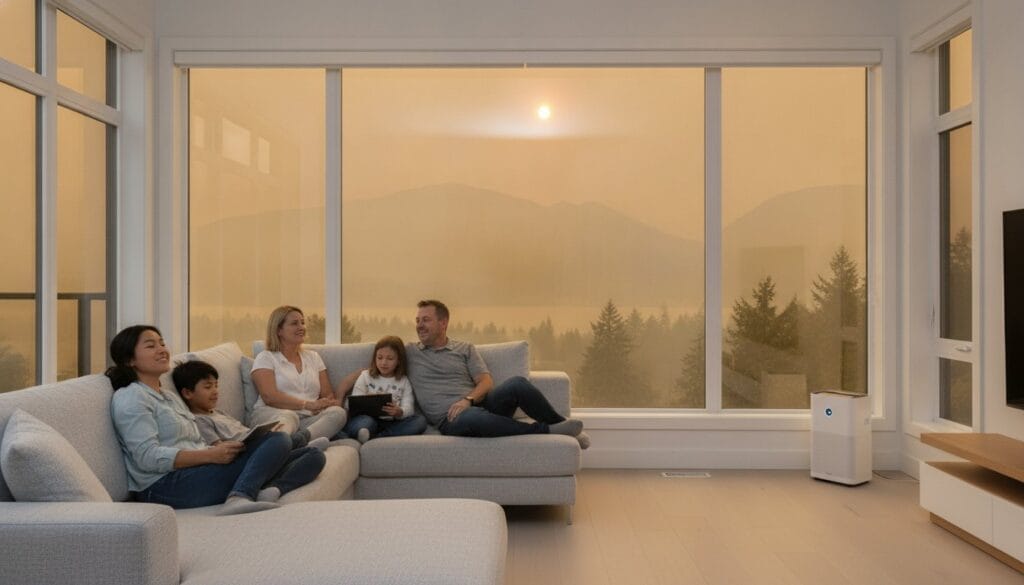

Last winter, you probably spent your mornings wiping thick condensation off your windows while trying to ignore the stale, lingering scent of last night’s dinner. In our Lower Mainland neighbourhood, the damp climate often turns modern, airtight homes into boxes that trap moisture and pollutants inside. You aren’t alone in feeling like your house simply can’t breathe. Many families realize that opening a window isn’t a practical solution when it’s freezing outside or when wildfire smoke fills the summer air. If you’re researching an ERV installation Lower Mainland residents can rely on for better air, you’re already on the right track to a healthier living space.
This guide will help you discover how an Energy Recovery Ventilator (ERV) improves your indoor air quality and boosts energy efficiency. We’ll explain how these systems recover heat and balance humidity to keep your home comfortable in every season. You’ll learn about the tangible benefits, including lower energy bills and a constant supply of fresh, filtered air without the drafts. We’ll also walk through the local requirements for strata approvals and the latest CleanBC rebate opportunities available for BC homeowners. By the end, you’ll have a clear roadmap to a fresher, more efficient home.
Key Takeaways
- Learn why modern, airtight BC homes require mechanical ventilation to prevent moisture buildup and improve long-term respiratory health.
- Understand the technical differences between HRVs and ERVs to determine which system best manages the unique humidity levels of the West Coast.
- Discover the importance of proper sizing and high-efficiency filtration to keep your indoor air clean during summer wildfire events.
- Explore the professional ERV installation Lower Mainland process, including how to navigate strata approvals and secure available CleanBC rebates.
- Find out how professional calibration ensures your ventilation system runs efficiently without increasing your monthly energy bills.
Why Modern Lower Mainland Homes Require Balanced Ventilation
Modern construction in British Columbia focuses heavily on energy efficiency. We build homes with tight seals to prevent heat loss, which is excellent for your utility bills but often detrimental to your health. Without a way for air to escape, your living space traps everything from carbon dioxide to moisture. This lack of natural air exchange is why many homeowners are now looking into Heat recovery ventilation (HRV) and ERV systems. It’s a shift from letting a house “leak” air to controlling exactly how it breathes.
When air becomes stagnant, it leads to what experts call “Sick Building Syndrome.” You might notice frequent headaches, itchy eyes, or a general sense of fatigue while indoors. These symptoms often disappear the moment you step outside. A professional ERV installation Lower Mainland homeowners choose can resolve these issues. These systems ensure a constant stream of fresh, filtered air enters your home while exhausting stale air, pollutants, and excess CO2.
The Impact of Indoor Air Quality in Coquitlam
In our local Tri-Cities area, indoor pollutants often exceed outdoor levels. Common culprits include volatile organic compounds (VOCs) from new furniture, pet dander, and seasonal allergens. For families dealing with asthma or severe allergies, these microscopic irritants make daily life difficult. You can find more details in our guide on indoor air quality Coquitlam to understand how these pollutants behave in our specific climate. Balanced ventilation doesn’t just move air; it filters it, removing these triggers before they reach your lungs.
Managing BC’s Unique Humidity Challenges
Our region is famous for its damp winters. If you see water pooling on your window sills, it’s a clear warning that your indoor humidity is too high. This excess moisture doesn’t just stay on the glass. It often migrates into wall cavities and attics. Over time, this leads to structural rot and hidden mould growth that can be incredibly expensive to remediate. High humidity also makes your heating system work harder. Damp air is more difficult to heat than dry air, which drags down your furnace’s efficiency and increases your monthly costs.
An ERV installation Lower Mainland service helps balance this moisture level. Unlike a standard fan, an ERV transfers humidity between the incoming and outgoing air streams. This keeps your home in the ideal range of 30 to 50 percent humidity. It protects your home’s structure while ensuring your family stays comfortable without the “heavy” feeling of damp air.
ERV vs. HRV: Comparing Ventilation Solutions for BC Homeowners
Choosing between a Heat Recovery Ventilator (HRV) and an Energy Recovery Ventilator (ERV) is a critical decision for your home’s climate control strategy. While both systems exchange stale indoor air for fresh outdoor air, they handle energy differently. An HRV transfers thermal energy, or heat, between the two air streams. In contrast, an ERV transfers both heat and moisture. This moisture transfer is known as latent energy recovery. For many homeowners considering an ERV installation Lower Mainland, the ability to manage humidity is the deciding factor.
The right choice often comes down to your household’s daily habits and the size of your home. A large family that cooks and showers frequently generates significant indoor moisture. In these cases, an HRV might be better for exhausting that excess humidity during our wet winters. However, if your home feels excessively dry when the heat is running, an ERV helps retain necessary moisture to keep your skin and respiratory system comfortable. It’s about finding the right balance for your specific living environment.
When to Choose an ERV in the Lower Mainland
In Port Coquitlam, ERVs are rapidly becoming the standard for new residential builds. These units are designed to keep your indoor humidity in a comfortable sweet spot. They prevent your home from becoming too dry in the winter while reducing the muggy feeling during our increasingly humid summers. Investing in an ERV provides long-term comfort that simple exhaust fans simply cannot match. If you’re unsure which system fits your floor plan, speaking with a certified technician can clarify your options based on your home’s airtightness.
The Synergy Between ERVs and Heat Pumps
Many residents are now pairing their ventilation with a heat pump installation Coquitlam to maximize efficiency. Heat pumps are incredibly effective at temperature control, but they can sometimes lead to dry indoor air during the heating cycle. An ERV works in perfect harmony with this technology by recovering energy from the exhaust air before it leaves the building. This reduces the overall workload on your heat pump, which can extend the lifespan of your equipment and lower your monthly energy costs.
This combination is also a key strategy for meeting the BC Energy Step Code requirements. By recovering a significant portion of the heat from exhausted air, you drastically lower your home’s carbon footprint. It’s the gold standard for modern, sustainable living in the Tri-Cities. When planning an ERV installation Lower Mainland, ensure your contractor understands how to calibrate the unit to work alongside your primary heating and cooling system for peak performance.
Key Factors for Choosing an ERV System in the Tri-Cities
Selecting the right hardware for an ERV installation Lower Mainland families can depend on requires looking at more than just the brand name. You need to understand the technical specifications that will impact your home’s comfort for the next decade. Every house has different needs based on its layout, age, and the number of people living inside. We focus on four primary metrics when helping you choose a unit.
- CFM Rating: This stands for cubic feet per minute. It measures how much air the unit can move. We size this based on your home’s total square footage and the number of rooms to ensure complete air exchange.
- Filtration Levels: Not all filters are equal. While basic filters stop large dust bunnies, high-efficiency options like MERV-13 are necessary for capturing finer particles.
- Core Material: Most modern units use a polymer core. These are generally more durable than older paper versions and are often washable, which simplifies your long-term maintenance.
- Noise Levels: Ventilation shouldn’t be loud. We look for units with low-sone ratings so your system runs quietly in the background without disturbing your sleep.
Wildfire Smoke Preparedness
Summer in BC now includes the reality of wildfire smoke. During these events, opening a window for “fresh” air is no longer an option. An ERV with high-grade filtration acts as a protective barrier for your family. Many modern units include a “recirculation mode.” This setting allows the system to continue filtering and moving air inside your home without pulling in the hazardous smoke from outdoors. It keeps your indoor air pure and cool while the air quality outside remains poor. This feature is a game-changer for residents with asthma or other respiratory sensitivities.
Ductwork Compatibility and Integration
Your current HVAC setup determines how we approach your ERV installation Lower Mainland project. If you have an existing forced-air system, we can often perform a simplified installation by connecting the ERV to your main return duct. Before we begin, it’s a good idea to ensure your duct cleaning Coquitlam service is up to date. Clean ducts ensure that the fresh air delivered by your ERV isn’t picking up years of dust on its way to your living room.
For homes with older equipment, we also check the condition of your blower motor. Sometimes, a quick furnace repair Port Coquitlam is necessary to ensure your existing system can handle the integrated airflow of a new ventilator. If your home doesn’t have central ducts, we can install a dedicated system. This involves running small, independent pipes to key areas like bedrooms and bathrooms, providing the most efficient air distribution possible.
The ERV Installation Process: From Ductwork to Calibration
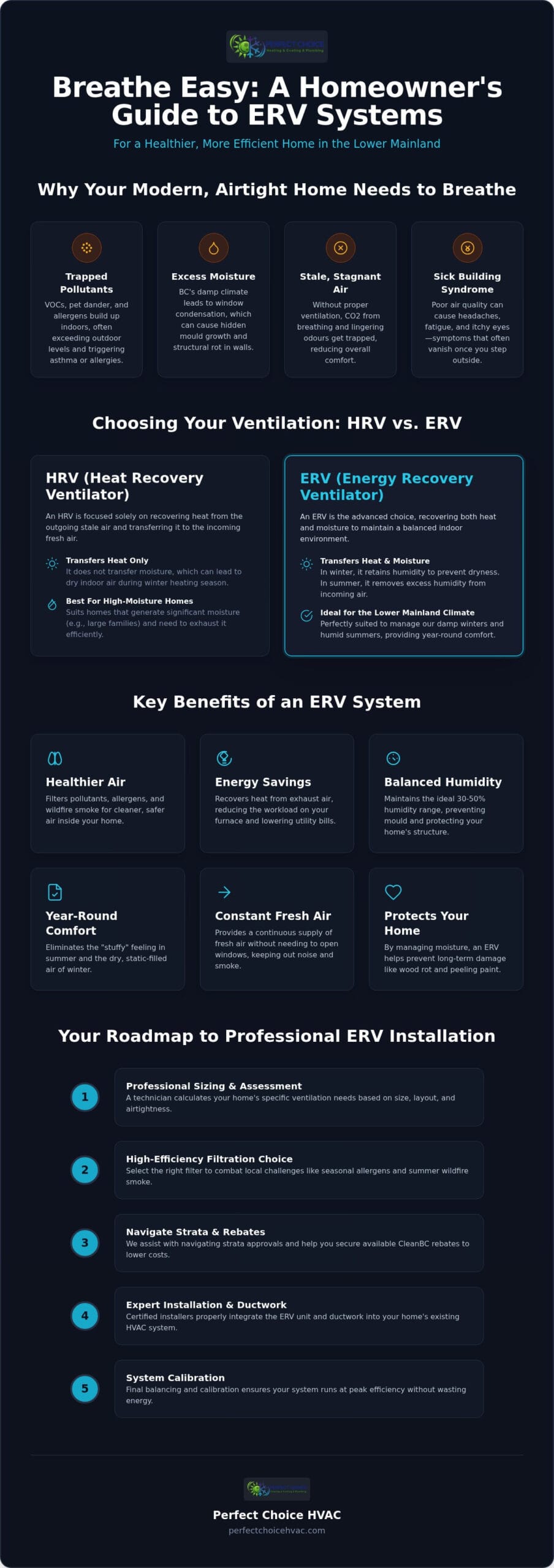
A professional ERV installation Lower Mainland project is a methodical process that transforms how your home breathes. It starts with a comprehensive site assessment. We don’t just look for a spot where the unit fits. We identify a central location, typically in a mechanical room or basement, that allows for the shortest, most efficient duct runs. This stage also involves planning the exterior penetration points. We ensure these hoods are placed in areas that won’t be blocked by future landscaping or heavy snowdrifts.
Once the location is set, we begin the ductwork installation. Think of these pipes as the lungs of your home. We install supply lines to deliver fresh air to dry rooms like bedrooms and living areas. Simultaneously, we install return lines to pull stale, moist air from wet rooms like bathrooms and laundry areas. If we’re integrating the system with your existing furnace, we use specialized transitions to ensure the two systems work together without competing for airflow. Finally, we slide in the polymer core and high-efficiency filters, ensuring every seal is airtight to prevent cross-contamination.
Professional Balancing and Commissioning
The most critical step in any ERV installation Lower Mainland homeowners invest in is the final balancing. A ventilation system that isn’t properly calibrated can cause pressure imbalances. If your home has negative pressure, it might pull in unconditioned air through cracks or backdraft combustion gases from a fireplace. Our technicians use digital anemometers to measure the exact velocity of air at every grille. We adjust the dampers until the intake and exhaust airflows are perfectly matched. This ensures your home stays pressurized correctly while meeting the specific ventilation rate required for your family size.
Exterior Vent Placement and Maintenance
Exterior hoods require strategic placement to maintain air purity. We follow strict safety codes, ensuring intake vents are located at least six feet away from exhaust points, gas metres, or dryer vents. This prevents the system from accidentally pulling “bad” air back into your living space. We also prioritize accessibility. You’ll need to clean the exterior screens once or twice a year to remove dust, leaves, or insects. During our local winters, we recommend checking these hoods for ice or snow blockages to keep the air flowing freely. If you’re ready to upgrade your home’s breathing, book an installation assessment with our local team today.
Professional ERV Installation & Rebates with Perfect Choice HVAC
Perfect Choice HVAC provides a complete, end-to-end service for your ERV installation Lower Mainland project. We understand that home upgrades can feel overwhelming, especially when they involve complex mechanical systems. Our team handles everything from the initial load calculations to the final system calibration. As a locally owned Coquitlam contractor with 8+ years of hands-on HVAC experience, we’ve built our reputation on transparency and technical precision. We don’t just install equipment; we design ventilation solutions tailored to the unique architecture of Tri-Cities homes.
Living in a multi-unit building or a managed complex often brings additional hurdles. We specialize in navigating the strata approval process for residents in Coquitlam, Port Coquitlam, and Port Moody. We provide the professional technical drawings, insurance certificates, and work schedules your strata council requires for approval. This proactive approach prevents delays and ensures your project stays compliant with building bylaws. Beyond the installation, our daily 7:00 AM–9:00 PM support ensures your indoor air quality is always protected, giving you peace of mind during extreme weather or smoke events.
Maximizing Your CleanBC and BC Hydro Rebates
In 2026, the CleanBC Better Homes program remains a primary driver for energy-efficient upgrades in British Columbia. The provincial government has committed $50 million annually through 2027 to support these initiatives. It’s important to remember that you must use a registered contractor to be eligible for these incentives. As a CleanBC registered contractor, we ensure your ERV installation Lower Mainland meets all specific efficiency criteria and installation standards. We handle the technical documentation and provide the clear invoicing needed for a successful rebate claim.
If you’re looking for the highest possible energy savings, consider combining your ventilation upgrade with a heat pump. This dual approach is often the most cost-effective way to modernize an older home’s HVAC system. We can help you identify which current incentives apply to your specific situation, ensuring you don’t leave money on the table. Our team stays updated on the latest income-qualified programs to ensure every homeowner has access to cleaner, more efficient air.
The Perfect Choice Guarantee
We believe in a hassle-free experience from start to finish. This begins with transparent, upfront estimates that include no hidden fees or surprise “add-ons” mid-project. Our licensed and insured technicians treat your property with the highest level of respect, using floor protection and maintaining a tidy workspace. We take the time to walk you through your new system’s controls so you feel confident managing your home’s air quality. Ready to transform your living environment? Book your free in-home estimate for an ERV installation Lower Mainland with our trusted local experts today.
Take Control of Your Home’s Indoor Environment
Investing in a balanced ventilation system is one of the most effective ways to protect your home’s structure and your family’s health. Throughout this guide, we’ve seen how ERVs manage the unique humidity challenges of our West Coast climate while keeping energy costs low. A professional ERV installation Lower Mainland homeowners trust ensures that your system is sized correctly, filtered properly, and calibrated for maximum efficiency. You don’t have to deal with lingering odours or winter window condensation anymore.
Perfect Choice HVAC is proud to be a CleanBC Registered Contractor, offering you the local expertise needed to navigate rebates and strata requirements. Our licensed and insured technicians provide daily 7:00 AM–9:00 PM support, so you’re never left without help when you need it most. We focus on a hassle-free experience that prioritizes your comfort and long-term satisfaction. It’s time to stop worrying about air quality and start enjoying a fresher, healthier home.
Breathe easier with professional ERV installation; request your free estimate today!
We’re ready to help you create the perfect indoor climate for your family. Reach out to our team and discover the difference that expert ventilation can make in your daily life.
Frequently Asked Questions
What is the main difference between an ERV and an HRV?
ERVs transfer both heat and moisture, while HRVs only transfer heat. This makes an ERV better for maintaining ideal humidity levels in your home. In our damp climate, an ERV helps keep indoor air from becoming too dry in winter. It also limits incoming humidity during the summer. This dual recovery of energy makes it a more comprehensive solution for year-round comfort in local homes.
Does an ERV replace my existing air conditioner or furnace?
No, an ERV is a ventilation system, not a primary heating or cooling source. It works alongside your furnace or air conditioner to provide fresh air without wasting energy. While it helps maintain temperature by recovering heat from exhausted air, it doesn’t have the capacity to heat or cool a whole house. Think of it as a partner that reduces the workload on your main HVAC equipment.
How much maintenance does an ERV system require?
Maintenance is minimal but essential for performance. You should clean or replace the air filters every three to six months, especially during high-pollen or wildfire seasons. The energy recovery core itself usually needs a quick vacuum or wash once a year. We also recommend checking exterior intake and exhaust hoods for blockages. Keeping up with these simple tasks ensures your system runs efficiently for its full lifespan.
Can an ERV filter out wildfire smoke during the summer?
Yes, provided you use the right filtration. Most modern units can be fitted with MERV-13 or HEPA filters that capture fine smoke particles. During heavy smoke events, you can also switch the unit to recirculation mode. This continues to filter the air already inside your home without drawing in hazardous outdoor air. It’s a vital feature for protecting your family’s respiratory health during British Columbia’s summer months.
Will installing an ERV make my home noisier?
A professional installation should not significantly increase noise levels. High-quality units are designed with insulated cabinets and quiet motors that run at a low decibel level. If you hear loud humming or whistling, it often indicates an unbalanced system or poor duct design. When we perform an ERV installation Lower Mainland project, we prioritize quiet operation by using vibration isolators and choosing units with low-sone ratings.
Are there rebates available for ERV installation in BC for 2026?
Yes, the CleanBC Better Homes program currently offers rebates for an ERV installation Lower Mainland residents can access in 2026. To qualify, you must use a registered contractor and install a system that meets specific energy performance standards. We help you navigate the application process and provide all the necessary documentation. Combining a ventilation upgrade with other energy-efficient improvements can often unlock even higher incentive amounts.
Is an ERV compatible with a ductless mini-split system?
Absolutely. Since mini-splits don’t provide any fresh air exchange, an ERV is the perfect companion for them. It handles the air quality and humidity needs while the mini-split manages the temperature. In these setups, we often install a dedicated duct system for the ERV. This ensures that fresh, filtered air reaches every room in your home without relying on a central furnace or traditional ductwork for air distribution.
How long does a typical ERV installation take to complete?
Most residential installations are completed within one full working day. A simplified installation that connects to your existing furnace ducts is often quicker. A fully dedicated system with new ductwork may take two days depending on the complexity of your home’s layout. We provide a clear timeline during your initial estimate. Our goal is to minimize disruption while ensuring your new system is perfectly balanced and calibrated for use.