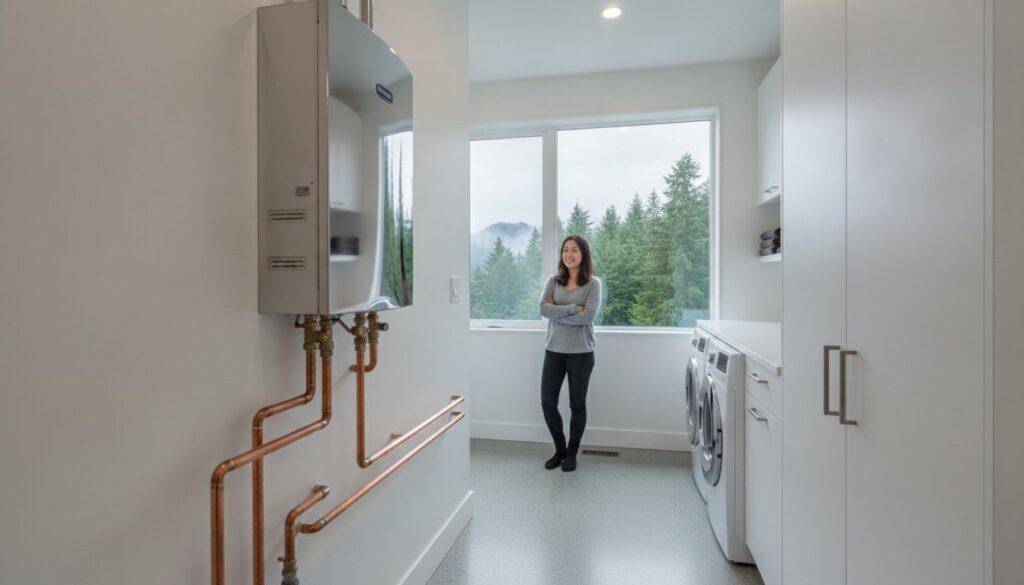
It’s 7:00 AM on a Tuesday in Coquitlam. You’re halfway through a shampoo when the water suddenly turns icy because someone started the dishwasher downstairs. You know that frustration all too well. It’s the daily gamble of living with an outdated tank that simply can’t keep up with your family’s morning rush. If you’re tired of high energy bills and conflicting sizing charts online, you’re not alone. Many homeowners realize that a professional tankless water heater installation is the best way to gain endless hot water while lowering monthly costs.
Choose tankless equipment using rated performance at your required flow and temperature rise. This guide explains information to gather before an estimate. Verify incentives separately; space-heating heat-pump rebates do not automatically apply to gas tankless heaters.
Key Takeaways
- Learn why matching BTU output to your peak demand is the secret to avoiding the “cold sandwich” effect and ensuring endless hot water.
- Discover how BC’s specific groundwater temperatures influence your flow rate and why temperature rise is the most important metric for local sizing.
- Follow our step-by-step guide to calculate your family’s peak hot water demand before committing to a tankless water heater installation.
- Identify the critical technical requirements for gas lines and venting that ensure your new system operates at maximum energy efficiency.
- Check equipment-specific incentive rules before including any rebate in your budget.
Why Correct Sizing is the Secret to Endless Hot Water
Sizing isn’t just a recommendation; it’s a technical requirement for a successful tankless water heater installation. In a traditional setup, you rely on a large bucket of pre-heated water. Tankless systems work differently. They use a powerful burner to flash-heat water the moment you turn on a tap. We measure this capacity in British Thermal Units (BTUs). To get the performance you expect, we must match the unit’s BTU output to your home’s peak hot water demand. This precision ensures the system can keep up when your family’s lifestyle puts the most pressure on the plumbing.
Tank vs. Tankless: A Different Sizing Logic
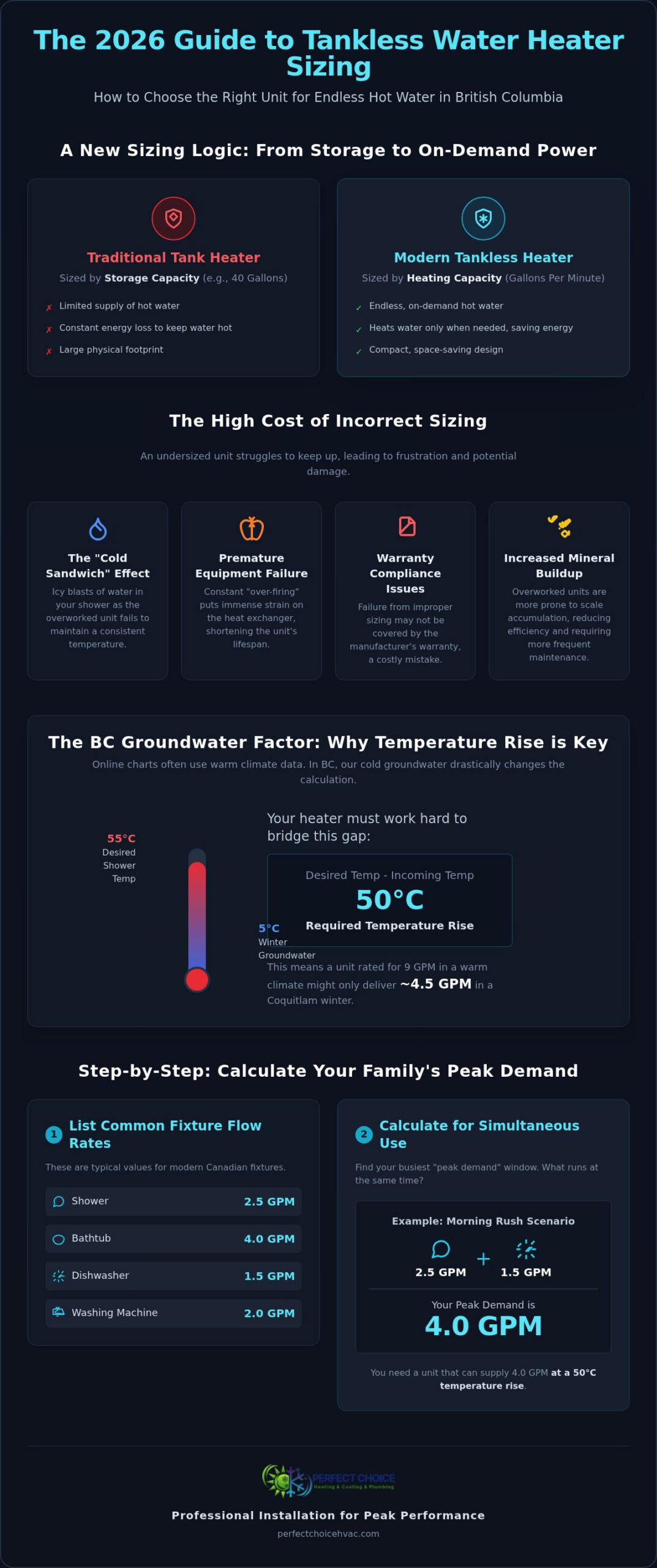
Many homeowners assume a 40-gallon tank should be replaced by a “medium” tankless unit. This logic doesn’t apply to modern systems. Traditional tanks are rated by storage volume, but tankless units are rated by flow rate, measured in Gallons Per Minute (GPM). You’re effectively shifting your focus from “storage capacity” to “heating capacity.” Understanding How Tankless Water Heaters Work reveals why flow rate is the most critical metric. If the unit is too small, it won’t be able to heat the water fast enough as it moves through the heat exchanger, leading to disappointing results during the morning rush.
The Consequences of Getting it Wrong
An undersized unit often leads to the “Cold Sandwich” effect. This happens when the burner fails to maintain a consistent temperature during frequent on-off cycles. You might feel a sudden, icy chill in the shower because the unit is struggling to catch up with the demand. Beyond the daily frustration, poor sizing actively damages your investment. When a unit is too small for the home, the burner must “over-fire” constantly to meet the set temperature. This puts immense strain on the heat exchanger and can lead to premature equipment failure.
Properly sizing your tankless water heater installation protects your home in several ways:
- Stabilizes Temperatures: You won’t experience fluctuations when someone starts the dishwasher or flushes a toilet.
- Extends Lifespan: Correct sizing prevents the internal components from reaching extreme temperatures that accelerate wear and tear.
- Warranty Compliance: Professional installation is required for warranty compliance. An incorrectly sized unit that fails from being overworked may not be covered by the manufacturer.
- Lower Maintenance: Units that operate within their intended capacity accumulate less mineral scale, which is vital for homes in the Lower Mainland.
We look closely at your household habits to find the “Peak Demand” window. By choosing a unit that matches your specific needs, you ensure that your transition to tankless is a one-time, high-value upgrade for your BC home.
Decoding Flow Rates and Temperature Rise for BC Homes
Success with a tankless water heater installation relies on understanding two specific numbers: Flow Rate and Temperature Rise. Flow rate is the volume of water your fixtures demand, measured in Gallons Per Minute (GPM). Temperature rise is the mathematical difference between the cold water entering your home and the hot water coming out of your showerhead. While these concepts seem simple, the math changes significantly when you live in the Pacific Northwest.
The BC Groundwater Factor
Tankless sizing starts with the cold-water inlet temperature, the required outlet temperature and the flow used at the same time. A catalogue maximum flow rate may be measured at a smaller temperature rise than your home needs in winter. Compare the selected model’s manufacturer flow chart with the actual design conditions. See the U.S. Department of Energy tankless sizing overview.
This seasonal variance is why some homeowners notice their water feels “less hot” in January. In reality, the heater is working just as hard; the incoming water is just significantly colder. Our team at Perfect Choice HVAC helps you select a high-BTU model that handles these winter lows without sacrificing your comfort. If you’re unsure about your home’s requirements, we can provide a professional assessment of your current plumbing to ensure your system is ready for the cold.
Common Fixture Flow Rates in Canada
To calculate your total demand, you need to know what your fixtures actually use. Most modern Canadian homes follow these standard flow rates:
- Standard showerhead: 1.5 to 2.5 GPM
- Kitchen faucet: 1.0 to 2.2 GPM
- Energy-efficient dishwasher: 1.0 to 2.0 GPM
- Washing machine: 1.5 to 2.0 GPM
List the fixtures you expect to use simultaneously and their measured flow rates. The installer should check this combined demand against the model’s rated output at the required temperature rise. Bathroom count or burner input alone cannot establish whether two showers and an appliance can run together.
Step-by-Step: Calculating Your Family’s Hot Water Demand
To get the most out of your upgrade, you need to look at your home’s busiest 15 minutes. This is your “Peak Demand” window. For most Coquitlam families, this happens between 7:00 AM and 8:00 AM when showers are running and the kitchen is active. Sizing for an average day is a common mistake that leads to cold showers during those critical moments. A successful tankless water heater installation starts with listing every fixture that might run at the exact same time.
The Simultaneous Use Test
Start by creating a simple list of your morning fixtures. If you follow Bob Vila’s guide to water heater sizing, you’ll see that calculating flow rates is the first step toward choosing the right model. We generally look at two common scenarios to help homeowners visualize their needs:
- Scenario A: The “Two Shower” Household. If two people shower at once using standard 2.5 GPM heads, your system must handle 5.0 GPM.
- Scenario B: The “Busy Family.” When you combine a shower (2.5 GPM) with a dishwasher (2.0 GPM) and a load of laundry (2.0 GPM), your peak demand hits approximately 6.5 to 7.5 GPM.
Always size for your busiest window, not your average usage. If you only size for one shower but occasionally run three, the system will prioritize temperature over flow, leading to a noticeable drop in water pressure at every tap.
Converting GPM to BTU Requirements
After establishing the design flow and temperature rise, compare the manufacturer’s capacity data. Confirm the gas supply, venting, condensate provisions and electrical requirements for the specific model before selecting equipment. A larger advertised BTU input does not remove these installation constraints.
Burner input alone does not establish capacity. Compare the manufacturer’s flow chart at the required temperature rise. If one appliance cannot meet the agreed simultaneous demand, discuss alternatives and their installation and operating costs.
Critical Installation Factors for Maximum Energy Efficiency
Sizing is only half the battle. Your home’s physical infrastructure must support the high demand of a tankless system to ensure it runs reliably. Most traditional tanks operate on a half-inch gas line. A tankless unit usually requires a three-quarter-inch line to deliver enough fuel to the burner instantly. If your gas metre or pipe diameter is too small, the unit will starve for fuel and shut down during peak use. This “BTU load” check is a mandatory part of any professional tankless water heater installation.
Condensing vs. Non-Condensing Units
Compare condensing and non-condensing models using published efficiency, venting and condensate requirements. The complete vent system must meet manufacturer instructions and applicable requirements; do not select vent materials from a generic guide.
Electrical and Gas Infrastructure Upgrades
Gas tankless appliances also require electricity for their controls and other components. Ask the installer to confirm the model’s supply requirements. For a strata property, obtain the current bylaws and written approval requirements before changing vents or common property. Equipment suitability and installation scope must be confirmed for your building.
Finally, consider your water quality. While Coquitlam’s water is relatively soft, mineral scale can still accumulate over the 15 to 20-year lifespan of the unit. We often recommend a scale prevention filter to protect the internal heat exchanger from buildup. Manufacturers require professional installation for warranty compliance. Without a certified technician’s sign-off, you risk losing your coverage if a component fails prematurely. If you’re ready to upgrade your home’s efficiency, you can book a technical site survey to see which infrastructure upgrades your specific home needs.
Professional Tankless Installation with Perfect Choice HVAC
Perfect Choice Heating & Cooling was established in 2023 and serves Coquitlam and the Tri-Cities. An installation estimate should identify the proposed model, sizing assumptions, gas-supply work, vent route, electrical work and any permit responsibilities. Request a written scope so you can compare the complete installation.
Rebate Assistance for Coquitlam Homeowners
Do not include an assumed rebate or federal loan in your budget. Program eligibility depends on the equipment and current rules; a space-heating heat-pump rebate does not automatically cover a gas tankless water heater. The Canada Greener Homes Loan is closed to new applications. Check any proposed water-heating incentive directly with its administrator before ordering.
Why Choose a Local Expert?
For a multi-family property, ask your council which equipment data, vent details and contractor records it requires. Written approval, permit requirements and the installation scope should be settled before work begins. Perfect Choice offers appointments daily from 7 AM–9 PM, subject to confirmed availability.
Follow the selected model’s maintenance instructions and water-quality requirements. Ask which tasks are appropriate and request a service quote. Maintenance does not guarantee a breakdown-free life or warranty coverage.
Secure Your Family’s Comfort with Endless Hot Water
Transitioning to a tankless system is one of the smartest upgrades you can make for your BC home. It ends the morning lottery of cold showers and cuts down on wasted energy. Success depends on more than just picking a unit off a shelf. You must account for our specific groundwater temperatures and your family’s unique peak demand window. A precise tankless water heater installation ensures your gas lines, electrical circuits, and venting are all optimized for long-term reliability.
Request a free tankless installation estimate or call 778-833-2893. Tell us your city, existing water heater and the fixtures you want to use together. Repair diagnosis and maintenance are quoted separately. Appointments are available daily from 7 AM–9 PM, subject to availability.
Frequently Asked Questions
Is a tankless water heater worth it in Coquitlam?
A tankless system may suit a home that needs on-demand hot water and supports its installation requirements. Compare full installation cost, rated capacity, usage, maintenance and energy prices with alternatives. Savings and service life vary.
What size tankless water heater do I need for a 4-bedroom house?
Bedroom count alone is insufficient. List simultaneous fixtures, flow rates and design temperature rise. Compare these with manufacturer capacity data and confirm gas, electrical and venting provisions before selecting equipment.
Can a tankless water heater run two showers at once in the winter?
Some systems can serve two showers together, but this must be checked against the selected model’s performance chart and the home’s incoming water temperature and fixture flow rates. Ask for the sizing assumptions in the installation estimate. Do not raise shower temperature to compensate for inadequate capacity; use appropriate temperature controls and follow Canadian scald-prevention guidance.
Do I need to upgrade my gas line for tankless water heater installation?
Most homeowners need a gas line upgrade when switching from a storage tank. Standard tanks often use a half-inch line, but tankless units require a three-quarter-inch line to handle the high BTU demand. Ensuring your infrastructure can support the tankless water heater installation is vital for safe and reliable operation. Our technicians perform a full load check of your gas metre and piping during the initial consultation.
How long does a professional tankless installation take?
A professional installation usually takes between 8 and 12 hours to complete. If your home requires significant upgrades to the gas line, electrical circuit, or venting, the process may extend into a second day. We aim to minimize your downtime so you aren’t without hot water for long. Our organized approach ensures that all technical calibrations and safety tests are finished thoroughly before we leave.
Does BC offer rebates for tankless water heaters in 2026?
Check the current rules for the exact water-heating equipment you plan to install. Eligibility for one utility or heat-pump program does not establish eligibility for a gas tankless system. Request an estimate showing the full price before any unapproved incentive, and confirm funding and application requirements directly with the program administrator.
How often does a tankless water heater need maintenance in BC?
Follow the model’s maintenance schedule and account for actual water conditions. Ask whether flushing, filter cleaning or inspection is due, request a quote and keep service records. Check the specific warranty terms.
Can I install a tankless water heater myself to save money?
You should never attempt to install a tankless water heater yourself. Professional installation is a legal requirement for gas-fired appliances in BC to ensure compliance with safety codes. Manufacturers almost always require a licensed technician’s sign-off to validate the warranty. A DIY approach risks gas leaks, improper venting, and system failure, which can be far more expensive than the cost of a professional setup and may void your insurance.