
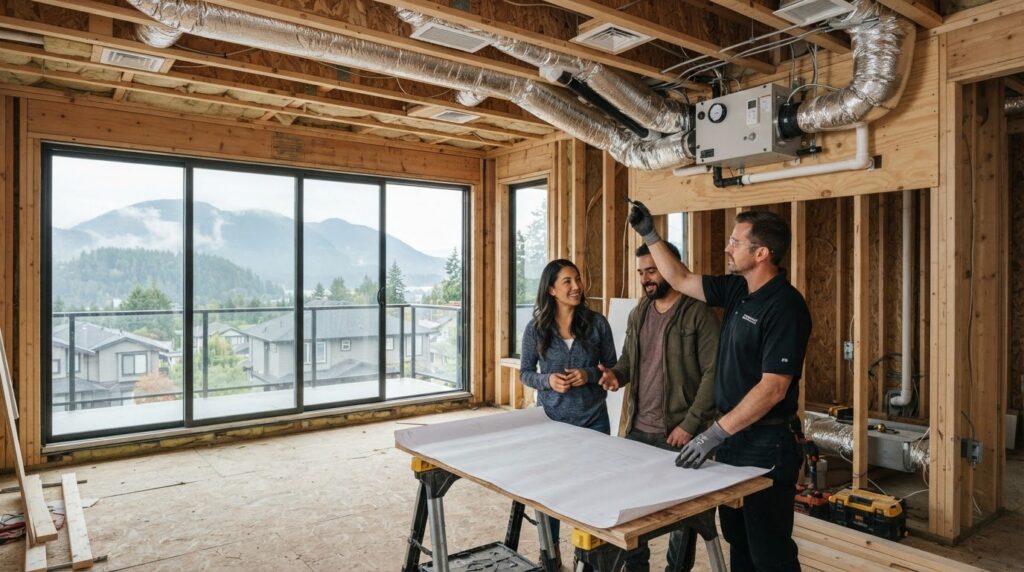
What if the HRV decision that causes the most trouble is the one left until the walls are closed? New-home ventilation needs to be planned alongside the layout, ductwork, and construction schedule. For HRV installation for new homes Port Coquitlam buyers, early coordination helps clarify what the system needs and who is responsible for each part of the work.
It’s reasonable to want a system that suits your home without creating last-minute changes for your builder or other trades. The right choice depends on the home’s ventilation design, not just the equipment. In British Columbia, new homes need a continuously operating mechanical ventilation system, so confirm how the proposed HRV fits the project plans and requirements.
This guide covers what to ask before selecting a system, how to coordinate equipment, ductwork, controls, and commissioning with the build schedule, and what to clarify with your builder and installer. You’ll also learn which project details to verify before moving forward with a clear scope and professional local support.
Key Takeaways
- Plan HRV installation for new homes Port Coquitlam alongside the ventilation design, so equipment and ductwork can be coordinated with the build.
- Compare systems by capacity, sound information, controls, service access, and fit with the home’s ventilation plan.
- Ask how sizing will be determined for your specific project rather than relying on a generic rule of thumb.
- Confirm who handles each part of the work, including connections, testing, and any electrical or other trade coordination.
- Gather your plans, build stage, schedule, and household needs before requesting a written scope review from an installer.
Why plan HRV installation early for a new Port Coquitlam home?
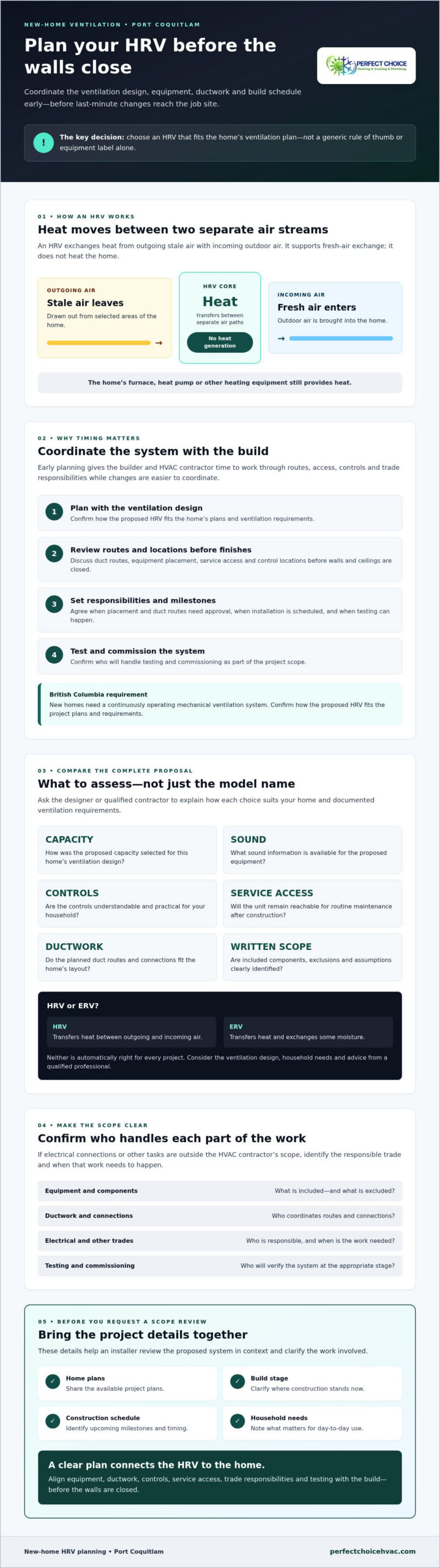
An HRV is a ventilation system that transfers heat from outgoing stale air to incoming fresh air. It recovers heat; it doesn’t heat the home. The home’s heating system still provides heat. An HRV can support fresh-air exchange in a tightly built home, but its design should suit the house and its ventilation requirements.
In new construction, ventilation is part of the home’s overall design, not simply a piece of equipment to fit in later. Planning HRV installation for new homes Port Coquitlam early gives the builder and HVAC contractor time to consider duct routes, equipment location, controls, and how installation will align with other work. It can also help catch access or routing issues before finishes are in place.
What does an HRV do in a new home?
An HRV draws stale air out of selected areas and brings fresh outdoor air into the home through separate airflow paths. As the two air streams pass through the heat-exchange core, heat moves from the outgoing air to the incoming air. The system doesn’t create heat or replace the furnace, heat pump, or other heating equipment. For a general overview of the operating principle and how HRVs differ from ERVs, see Heat Recovery Ventilation (HRV).
The design matters. Required airflow, equipment selection, and duct layout depend on the home and the applicable requirements for the project. Ask the designer or qualified contractor to explain how the proposed system fits the ventilation plan. Avoid choosing capacity based on a generic rule of thumb.
Why does installation timing matter in Port Coquitlam?
Before ceilings and walls are closed, the project team can review duct routes, unit access for service, and control locations. These decisions may affect framing, mechanical work, finishing, and coordination with other trades. If electrical connections or other tasks are outside the HVAC contractor’s scope, confirm who is responsible and when that work needs to happen.
Port Coquitlam is the local setting, but each new home has its own plans and construction sequence. Confirm key milestones with the builder and HVAC contractor: when equipment placement and duct routes need approval, when installation is scheduled, and when the system can be tested. Clear timing and responsibilities keep the ventilation plan connected to the build from rough-in through completion.
How to choose an HRV system for a Port Coquitlam new build
Start with the ventilation plan, not a model name or rule of thumb. The proposed system needs to match the home’s design and documented requirements. HRV capacity should be selected to meet the home’s ventilation design, not chosen by guesswork. Ask the designer or qualified contractor to explain how the equipment and planned airflow suit your project.
For HRV installation for new homes Port Coquitlam, compare the complete proposal, not just the unit. Review the equipment, controls, ductwork connections, access for routine maintenance, and how the system fits the ventilation plan. Request product documentation and a written scope that identifies included components, exclusions, and assumptions. For additional technical background, RDH Building Science’s HRV Installation Guide discusses HRV design, installation, and operation.
Which HRV features should buyers compare?
Ask the contractor to explain the proposed capacity and how it relates to the home’s documented ventilation requirements. Compare control usability, available sound information, and whether the unit will be reachable for service after construction. Review the product information, too. A clear proposal should identify the equipment and components included, what is excluded, and who will handle work outside the HVAC scope.
Look beyond the equipment label. A control may offer many features but still need to be straightforward for your household to use. The unit’s location should also allow practical service access without disrupting finished areas. Ask how these choices fit the plans rather than assuming one feature or capacity suits every new home.
Should a new home use an HRV or an ERV?
An HRV transfers heat between outgoing and incoming air. An ERV transfers heat and also exchanges some moisture. Neither is automatically the right choice for every project. The decision should reflect the home’s ventilation design, household needs, and advice from a qualified professional. For more detail, read the HRV versus ERV comparison.
Before approving a system, ask the installer why it suits the project and what the stated scope covers. If you’re reviewing options for a Port Coquitlam build, discuss the proposed design and installation scope with a local provider of HRV and ERV system installation.
What happens during HRV installation in a new Port Coquitlam home?
The installation sequence depends on the home’s design, build stage, and agreed scope. Typically, the project team reviews the plans and responsibilities, installs the unit and duct connections, then checks operation and explains the controls. The order and timing can vary. Site access, construction sequencing, and design changes all affect scheduling, so don’t rely on a fixed installation timeline.
For HRV installation for new homes Port Coquitlam, confirm project-specific permit, inspection, and applicable BC Building Code requirements with the builder and HVAC contractor. Ask who will check the requirements and arrange any necessary approvals or inspections. Don’t assume these tasks are included in an installation quote unless the written scope says so.
How should the HRV coordinate with the builder and other trades?
Before work begins, agree on who supplies the equipment, completes the ductwork, provides or installs controls, and schedules site access. Confirm the unit location, service clearance, and duct routes with the builder before the relevant areas are enclosed. If electrical, structural, or other trade work is needed, clarify who will arrange it. Record decisions and scope changes in writing so the builder and HVAC contractor are working from the same plan.
Construction dates can shift. Ask which milestones matter for the HRV work, including when routes and equipment placement must be finalized, when installation can take place, and when testing is expected. If plans change, check how the adjustment affects other trades and the agreed scope before work proceeds.
What should commissioning and handover include?
Before the project is considered complete, ask what testing is included. This may involve checking airflow, setting up controls, and confirming that the system operates as intended, but the exact work should be stated in the scope. Request product documentation and clear instructions for everyday operation and maintenance. Make sure you know who to contact if the system needs attention or adjustment after occupancy.
A practical handover gives you more than a switch to operate. Ask the installer to demonstrate the controls and explain normal sounds or operating modes described in the product information. Keep the documents with your home records, and confirm any follow-up responsibilities with the builder and contractor. Clear answers help you understand what was installed and how to care for it.
How to assess an HRV installer for a Port Coquitlam new home
A strong proposal explains more than which unit will be supplied. It should show how the equipment fits the home’s ventilation design, what the installation includes, and how the work will be coordinated with the builder. For HRV installation for new homes Port Coquitlam, look for clear written answers before approving the scope.
Use this checklist when reviewing an installer:
- Qualifications: Ask who will complete the work and what relevant qualifications, insurance, and experience they can confirm.
- Design responsibility: Clarify who confirms the system design and how the proposed equipment matches the project documents.
- Equipment and scope: Request equipment details, included components, control work, installation tasks, and any exclusions.
- Testing and handover: Ask what checks, documentation, operating instructions, and after-installation support are included.
- Coordination: Confirm who handles site access, scheduling, and work assigned to the builder or other trades.
Questions to ask before approving an HRV proposal
Ask, “Who confirms that this system matches the ventilation design?” Then clarify whether the proposal includes duct connections, controls, testing, and a homeowner handover. Find out which items depend on the builder or another trade, such as access at a particular construction stage or work outside the HVAC scope. Written answers help prevent project partners from making conflicting assumptions.
Perfect Choice HVAC’s technicians are licensed, insured, and certified, and the company offers free in-home estimates. Since this is a new build, confirm whether an estimate is available for your project type and what it covers. For wider context on home ventilation, see the Coquitlam indoor air quality guide.
How can you compare proposals fairly?
Compare like with like. Review the proposed equipment specifications and installation scope, not just brief descriptions or headline claims. Check that each proposal identifies assumptions, exclusions, schedule dependencies, and who is responsible for coordination. If a quote mentions energy savings, performance results, or rebates, ask for the basis and verify whether the claim applies to your project. Don’t treat an unqualified promise as a substitute for documented details.
Before choosing, ask the installer to walk through unclear line items with you and your builder. To discuss an HRV installation scope, contact Perfect Choice HVAC about HRV installation.
Arrange HRV installation for your new Port Coquitlam home
A little preparation makes it easier to discuss the right next steps for HRV installation for new homes Port Coquitlam. Gather the available plans, confirm the current construction stage with your builder, and note household priorities, such as control preferences or maintenance questions. Then request a review of the proposed ventilation design and installation scope.
- Share the basics: Provide the Port Coquitlam location, home type, construction stage, and target schedule.
- Gather project documents: Include available plans, ventilation specifications, and relevant equipment or control details.
- Identify project contacts: Share the builder’s contact information, if appropriate, and clarify who is coordinating site access.
- List your questions: Note what you want to understand about system operation, maintenance, responsibilities, or scheduling.
What information should you prepare for an estimate?
Send the documents you have, even if some design details are still being finalized. Ask what additional site information the contractor needs before confirming equipment and scope. Perfect Choice HVAC provides HRV and ERV system installation and offers free in-home estimates. Confirm whether an estimate is available for your new-build project and what it includes before arranging one.
What should happen after the initial consultation?
Use the discussion to clarify the proposed system, included work, exclusions, project responsibilities, and scheduling dependencies. Ask how design changes or construction delays may affect the scope or installation date. Before proceeding, have the agreed details recorded in writing and confirm who will communicate updates between the HVAC contractor and builder.
For additional context on ventilation planning, see the new-home ventilation planning guide. It can complement your project review but doesn’t replace advice based on your plans and site conditions.
Perfect Choice HVAC serves residential customers in Port Coquitlam and nearby Lower Mainland communities, including Coquitlam, Port Moody, and Maple Ridge. If you’re considering HRV or ERV installation, contact Perfect Choice HVAC to discuss your project and confirm availability, scope, and possible next steps.
Plan your HRV project with confidence
A successful new-home ventilation project starts with clear coordination. Confirm that the proposed system fits the home’s ventilation design, and agree on equipment, ductwork, controls, testing, and responsibilities before construction reaches the finishing stage. A written scope helps you and your builder understand what’s included and what still needs to be arranged.
For HRV installation for new homes Port Coquitlam, gather your plans, construction stage, schedule, and questions before speaking with an installer. Perfect Choice HVAC provides HRV and ERV system installation in Port Coquitlam and the surrounding Lower Mainland, including Coquitlam, Port Moody, and Maple Ridge. The company offers free in-home estimates, so ask whether one is available for your new-build project and what it covers.
Request a free in-home estimate for your new-home HRV project and discuss the project details, availability, and next steps. With a clear plan and the right people coordinating the work, you can move forward with greater confidence.
Frequently Asked Questions
When should an HRV be installed during new-home construction?
Plan the HRV early, before duct routes and equipment locations are concealed by finished walls or ceilings. The exact installation stage depends on the home’s design and construction sequence. Confirm with your builder and HVAC contractor when plans, unit location, ductwork, controls, installation, and testing need to be coordinated. Early discussion gives the project team time to identify access needs and responsibilities before they affect other work.
How do I choose the right HRV system for my Port Coquitlam home?
Choose an HRV that matches the home’s ventilation design, not a generic sizing rule. Ask the designer or qualified contractor to explain the proposed capacity and how it aligns with project requirements. Compare equipment documentation, control usability, sound information, maintenance access, and the written installation scope. For HRV installation for new homes Port Coquitlam, also confirm how the equipment and ductwork fit the plans and construction schedule.
Should a new home have an HRV or an ERV?
The choice depends on the home’s design and household needs, so neither system is automatically best for every project. An HRV transfers heat between outgoing and incoming air. An ERV transfers heat and also exchanges some moisture. Ask the designer or qualified contractor which option suits the project and why. Review the proposal’s equipment details and confirm the chosen system aligns with the ventilation plan.
Does HRV installation in a new home require a permit in Port Coquitlam?
Permit requirements depend on the specific project, so confirm them before work begins. Ask your builder and HVAC contractor whether permits or inspections apply, who is responsible for confirming them, and how they fit the construction schedule. You can also check directly with the City of Port Coquitlam. Don’t assume permit handling is included in an installation scope unless the written proposal clearly says so.
What should an HRV installation quote include?
A clear quote should identify the proposed equipment and explain how it fits the ventilation design. It should also state which installation tasks, components, duct connections, controls, testing, and documentation are included. Check for written exclusions, assumptions, schedule dependencies, and responsibilities assigned to the builder or other trades. If a proposal makes savings, performance, or rebate claims, ask for supporting details and verify whether they apply to your project.
How is an HRV system tested before a new home is occupied?
Ask the contractor what checks are included in the project’s testing and handover. Depending on the scope, this may include airflow checks, control setup, and operational testing. Request an explanation of normal operation, product documentation, and maintenance instructions. Confirm who to contact if the system needs attention after occupancy. For homeowners in Port Coquitlam, Coquitlam, Port Moody, and Maple Ridge, the project team can clarify responsibilities based on the home and installation scope.